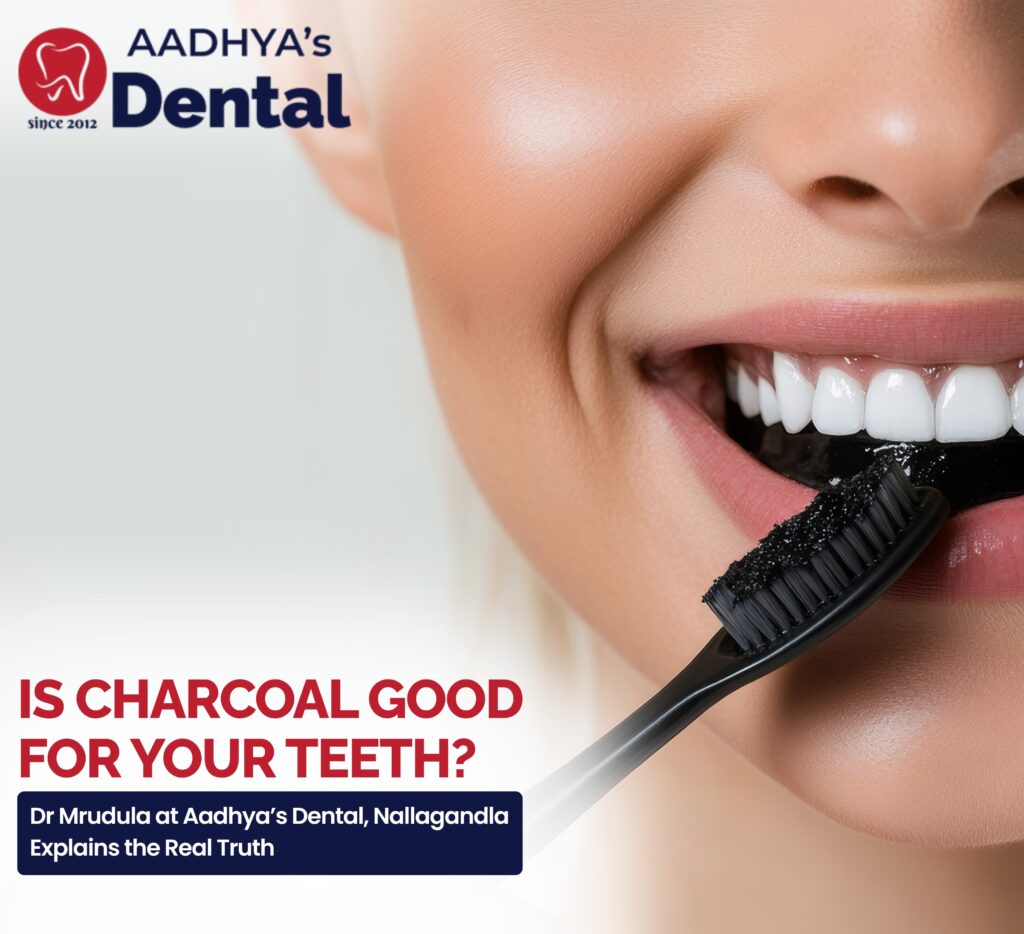
Charcoal toothpastes and activated charcoal powders have become a major trend in oral care. Promoted heavily on social media as a “natural teeth whitening” and detox solution, many people are now asking an important question:
Is charcoal actually good for your teeth?
At Aadhya’s Dental, Nallagandla, Hyderabad, we frequently see patients from Nallagandla and Tellapur who use charcoal products hoping for whiter teeth—often without knowing the long-term effects. Let’s break down what charcoal does, what science says, the risks involved, and safer alternatives recommended by dentists.
What Is Charcoal in Dental Products?
Activated charcoal is a form of carbon that has been processed to create millions of microscopic pores, increasing its surface area. Because of this structure, it can adsorb (bind to the surface of) stains, debris, and certain compounds.
Today, charcoal is commonly found in:
- Charcoal toothpastes
- Loose activated charcoal powders
- Charcoal-based mouth rinses
While the black foam may look impressive, “natural” does not always mean safe for daily dental use.
What Does Science Say About Charcoal for Teeth?
Possible Benefits (Limited)
1. Mild surface stain removal
Charcoal is slightly abrasive, which means it can polish away superficial stains caused by tea, coffee, or smoking. However, this effect is temporary and only affects the outermost stains.
2. Psychological or cosmetic appeal
The visual effect of charcoal turning black while brushing creates a perception of “deep cleaning,” though this is more of a placebo or marketing effect than a proven dental benefit.
Major Risks & Downsides You Should Know
1. Enamel erosion due to abrasiveness
Many charcoal products are more abrasive than regular toothpaste. With frequent use, this can:
- Wear down tooth enamel
- Increase tooth sensitivity
- Make teeth more prone to cavities and staining
Once enamel is lost, it cannot grow back.
2. Lack of fluoride protection
Most charcoal toothpastes do not contain fluoride, which is essential for:
- Strengthening enamel
- Preventing tooth decay
- Protecting against acid attacks
Using charcoal instead of fluoride toothpaste increases your risk of cavities.
3. No strong scientific evidence for whitening
There is limited high-quality clinical research proving that charcoal significantly whitens teeth. Any whitening effect is usually mild, uneven, and short-lived.
More Info: https://aadhyasdental.com/teeth-whitening-treatment-in-nallagandla/
4. Uneven colour & residue problems
Charcoal particles can lodge in:
- Cracks in enamel
- Gum margins
- Dental restorations
This may cause patchy whitening or leave black residue that looks unattractive.
5. Gum irritation
The gritty texture of charcoal can irritate gums, especially in patients with:
- Gum recession
- Sensitive gums
- Periodontal disease
6. Masks real dental problems
Charcoal may temporarily hide yellowing caused by:
- Enamel thinning
- Tooth decay
- Internal staining
But it does not treat the root cause, potentially delaying proper dental care.
So, Is Charcoal Good for Your Teeth?
The honest dental answer:
❌ Not recommended for daily use
Due to its abrasiveness, lack of fluoride, and unclear long-term safety, most dentists—including our team at Aadhya’s Dental, Nallagandla—do not advise charcoal toothpaste as a regular oral hygiene product.
Occasional use (with caution)
If someone insists on trying charcoal:
- Use it very sparingly (no more than once a week)
- Never replace your regular fluoride toothpaste
Even then, it’s not the safest option.
If You Still Want to Use Charcoal: Safety Tips
| Best Practice | Why It Matters |
| Choose low-abrasive charcoal | Reduces enamel damage |
| Use a soft toothbrush. | Prevents excessive wear |
| Limit usage | Once a week, maximum |
| Brush with fluoride toothpaste afterwards | Restores enamel protection |
| Stop if sensitivity occurs. | Early sign of enamel damage |
| Get dental checkups | A dentist can monitor enamel health. |
Safer & More Effective Teeth Whitening Alternatives
At Aadhya’s Dental Clinic, Nallagandla, we recommend evidence-based whitening options that protect your teeth:
✔ Professional cleaning (scaling & polishing)
Safely removes surface stains and plaque—often enough to brighten your smile.
✔ In-office teeth whitening
Dentist-supervised whitening gives faster, controlled, and safer results.
✔ Dentist-guided take-home whitening kits
Custom trays and gels designed to minimise sensitivity and maximise results.
✔ Fluoride-based whitening toothpastes
Contain gentle polishing agents and enamel-safe ingredients.
✔ Enamel protection treatments
Fluoride varnishes and remineralising agents help prevent future staining.
Our Approach at Aadhya’s Dental, Nallagandla
When patients ask about charcoal or whitening, we follow a careful process:
- Evaluate enamel thickness and gum health
- Identify the true cause of tooth discolouration
- Recommend a safe, personalised whitening plan
- Educate on diet, habits, and stain prevention
- Monitor results and sensitivity
This ensures long-term oral health, not just temporary cosmetic fixes.
More Info: https://aadhyasdental.com/best-dental-clinic-in-nallagandla-aadhya-dental-clinic/
Conclusion: Should You Use Charcoal on Your Teeth?
While charcoal may seem like a quick, natural fix, the risks often outweigh the benefits. Enamel damage, lack of fluoride, and gum irritation can lead to bigger dental problems over time.
If you’re looking for safe teeth whitening in Nallagandla or Tellapur, it’s always best to consult a qualified dentist.
At Aadhya’s Dental, Nallagandla, Hyderabad, we help patients choose proven, enamel-safe solutions for a healthier, brighter smile—without compromising long-term dental health.
Book your consultation today and get expert guidance you can trust. Call today: +91-73962 35802