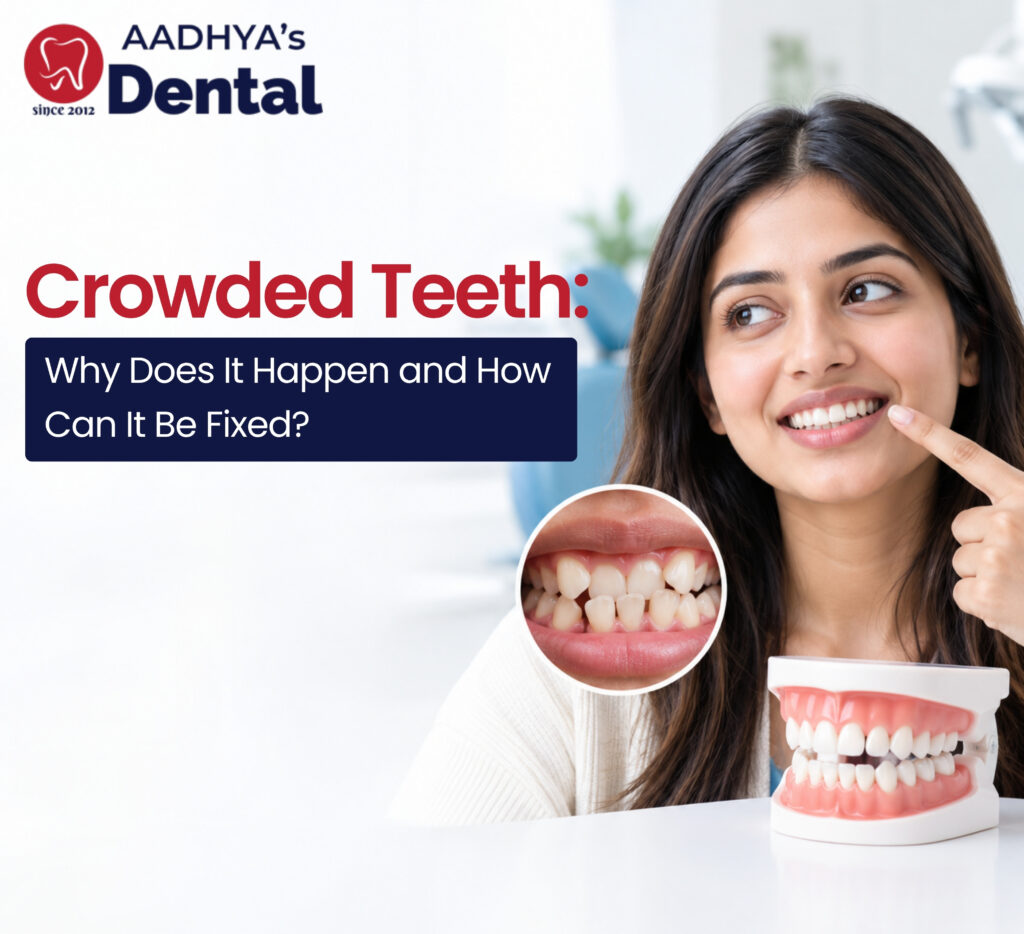
Have you noticed that your teeth overlap, twist, or appear tightly packed together? You may be dealing with crowded teeth, one of the most common orthodontic problems seen in children, teenagers, and adults.
Dental crowding is not always just a cosmetic concern. When teeth overlap or are positioned too closely, cleaning between them can become difficult. In some people, crowding can also be associated with bite problems, difficulty maintaining oral hygiene, or concerns about the appearance of the smile.
The good news is that crowded teeth can often be corrected with orthodontic treatmen
t. Depending on the patient’s age, severity of crowding, bite, jaw development, and overall oral health, treatment options may include traditional braces or clear aligners.
At Aadhya’s Dental, Nallagandla, crowded teeth are evaluated as part of a comprehensive dental assessment. The focus is not simply on making teeth look straight but on understanding the cause, assessing the bite and supporting tissues, and selecting an appropriate treatment approach for the individual patient.
For further information about choosing the perfect time for your dental visit, also read: https://aadhyasdental.com/choosing-the-perfect-time-for-your-dental-visit/
What Are Crowded Teeth?
Dental crowding occurs when there is not enough available space for the teeth to align properly within the dental arch.
Instead of sitting neatly beside each other, teeth may:
- Overlap
- Rotate
- Tilt forward or backward
- Erupt out of their normal position
- Sit behind or in front of neighbouring teeth
- Become tightly packed together
Crowding can range from mild to severe.
For example, someone may have a small amount of overlapping in the lower front teeth, while another person may have several permanent teeth significantly displaced because of insufficient space.
A dental or orthodontic examination is needed to determine the severity and underlying cause.
Why Does Dental Crowding Happen?
There isn’t always one single reason for crowded teeth. Several factors can contribute to the condition.
1. Genetics
Genetics can influence the size and shape of your teeth and jaws.
If the teeth are relatively large compared with the available jaw space, there may not be enough room for all the teeth to align properly.
Similarly, inherited jaw size and facial growth patterns can influence dental alignment.
This is why crowded teeth can sometimes run in families.
2. Tooth and Jaw Size Mismatch
One common reason for crowding is a mismatch between tooth size and available jaw space.
If the teeth require more space than the dental arch provides, they may overlap or rotate.
This is one of the reasons why orthodontic treatment focuses on the entire dental arch rather than simply looking at one crooked tooth.
3. Early Loss of Baby Teeth
Baby teeth play an important role in maintaining space for permanent teeth.
If a baby tooth is lost prematurely because of:
- Tooth decay
- Trauma
- Infection
- Other dental problems
nearby teeth may move into the space.
When the permanent tooth eventually tries to erupt, there may not be sufficient room.
This can contribute to crowded teeth in children.
Maintaining good children’s dental health and treating dental problems early can therefore be important for normal dental development.
4. Delayed or Abnormal Tooth Eruption
Permanent teeth generally follow a predictable eruption pattern.
Sometimes a tooth may erupt late, become trapped, or emerge in an unusual position.
This can contribute to crowding or displacement of neighbouring teeth.
Parents should discuss unusual tooth eruption patterns with their dentist rather than simply waiting indefinitely for the tooth to appear.
5. Oral Habits During Childhood
Certain prolonged oral habits can influence developing teeth and jaws.
Examples include:
- Thumb sucking
- Prolonged pacifier use
- Tongue-thrusting habits
The effect varies depending on the habit, its duration, frequency and the child’s stage of development.
If a child has persistent oral habits together with tooth alignment concerns, an early dental assessment may be helpful.
6. Missing or Extra Teeth
A missing permanent tooth can alter the position of neighbouring teeth.
Similarly, an extra tooth may interfere with the normal eruption of other permanent teeth.
Both situations can affect dental alignment and may require a comprehensive assessment.
Why Do Teeth Become More Crowded as We Get Older?
A common question adults ask is:
“My teeth were straight when I was younger. Why are they becoming crowded now?”
Teeth are not permanently fixed in exactly the same position throughout life.
Natural changes in the supporting tissues and tooth contacts can contribute to gradual movement.
Some people notice increasing crowding in the lower front teeth over time.
Previous orthodontic treatment can also be relevant. If retainers are not worn as recommended after braces or aligner treatment, teeth can gradually shift from their corrected positions.
If you notice new or worsening crowding, a dental examination can help identify possible causes.
Are Crowded Teeth a Cosmetic Problem Only?
Not necessarily.
For some people, crowded teeth are mainly an aesthetic concern.
However, significant crowding can sometimes make it more difficult to maintain good oral hygiene.
When teeth overlap, certain surfaces and spaces can be harder to reach with a toothbrush or floss.
This may contribute to plaque accumulation and increase the risk of:
- Tooth decay
- Gingivitis
- Gum disease
- Bad breath
- Localised gum problems
Crowding can also sometimes be associated with an uneven bite or tooth wear.
Therefore, treating crowded teeth can be about both oral health and smile aesthetics.
How Can Crowded Teeth Be Fixed?
The appropriate treatment depends on the severity and cause of crowding.
A dental professional may consider:
- The amount of available space
- Severity of crowding
- Bite relationship
- Jaw development
- Age
- Gum and bone health
- Position of individual teeth
- Presence of missing or extra teeth
- Previous orthodontic treatment
- Patient preferences and goals
Treatment should therefore be personalised.
1. Traditional Braces for Crowded Teeth
Traditional braces remain one of the most established options for correcting dental crowding.
Brackets and orthodontic wires apply controlled forces to gradually move teeth into planned positions.
Braces may be suitable for:
- Children
- Teenagers
- Adults
- Mild to complex alignment problems
The duration of treatment varies depending on the complexity of the case.
2. Clear Aligners for Crowded Teeth
Clear aligners are transparent, removable trays designed to gradually move teeth.
For appropriately selected patients, clear aligners or Invisalign can be an alternative to traditional braces.
They may be considered for certain cases involving:
- Mild to moderate crowding
- Spacing
- Selected bite problems
- Orthodontic relapse
However, not every case of crowded teeth can be treated in the same way with clear aligners.
The suitability of Invisalign depends on the type and amount of tooth movement required.
Patients searching for Invisalign in Nallagandla should therefore have an orthodontic assessment before deciding whether clear aligners are the right option.
3. Early Orthodontic Assessment for Children
Crowding in children should not automatically be treated immediately.
Sometimes the best approach is to monitor dental development and determine the appropriate time for intervention.
An early assessment can help identify:
- Lack of space
- Abnormal eruption
- Developing bite problems
- Prolonged oral habits
- Premature loss of baby teeth
- Jaw development concerns
In selected cases, early orthodontic treatment may help manage developing problems.
In other children, observation and regular dental monitoring may be more appropriate.
4. Orthodontic Treatment for Adults
Adults can also successfully undergo orthodontic treatment for crowded teeth.
Adults may seek treatment because:
- They never had braces as children
- Their teeth have shifted over time
- They stopped wearing retainers
- Crowding has become more noticeable
- They want to improve their smile
- They find certain areas difficult to clean
Before starting orthodontic treatment, adult patients should have their overall oral health evaluated.
Existing cavities, gum disease, missing teeth, worn teeth, crowns or other dental concerns may need to be addressed as part of the treatment plan.
Does Crowding Always Mean Teeth Need to Be Removed?
Not necessarily.
Patients sometimes hear the word “crowding” and immediately worry that teeth will have to be extracted.
However, treatment planning is individual.
Whether extraction is required depends on factors such as:
- Severity of crowding
- Tooth size
- Jaw size
- Facial profile
- Bite relationship
- Available space
- Position of the teeth
- Overall treatment objectives
Some cases can be managed without extraction, while other situations may require space to be created in a carefully planned way.
A proper assessment is essential before making this decision.
Can Crowded Teeth Be Fixed Without Braces?
In selected cases, yes.
Clear aligners such as Invisalign can correct certain types of crowding without traditional brackets and wires.
However, the phrase “without braces” should not be interpreted as meaning that every crowded-teeth case can be treated with aligners.
The severity and complexity of the crowding matter.
An experienced dental professional can evaluate your teeth and explain which options are realistic for your particular case.
A Comprehensive Approach to Crowded Teeth at Aadhya’s Dental
At Aadhya’s Dental, Nallagandla, crowded teeth are not assessed simply by looking at how they appear in a photograph.
A comprehensive evaluation may consider:
- Tooth alignment
- Available space
- Bite relationship
- Jaw relationship
- Gum health
- Tooth decay
- Oral hygiene
- Tooth eruption
- Missing or extra teeth
- Previous orthodontic treatment
- Age and growth
- Patient expectations
This comprehensive approach is particularly important because two patients with similar-looking crowding may have very different underlying causes.
Patient-centred care with Dr Mrudula
Dr Mrudula follows a patient-centred approach, taking time to understand the patient’s concerns and explain the findings and possible treatment options.
For parents, this may mean explaining whether their child’s crowding requires early intervention or simply monitoring.
For adults, the conversation may include aesthetic preferences, lifestyle, treatment convenience and whether braces or clear aligners would be appropriate.
The objective is to help patients understand their options rather than recommending the same treatment for everyone.
Also Read : https://aadhyasdental.com/meet-dr-g-mrudula-periodontist-oral-implantologist-at-aadhyas-dental/
How Can You Prevent Crowding From Becoming Worse?
Not every cause of crowding can be prevented.
However, maintaining good oral health during childhood and adulthood can help reduce some avoidable contributors.
Important habits include:
- Regular dental checkups
- Treating cavities in baby teeth promptly
- Maintaining good oral hygiene
- Addressing prolonged thumb sucking or other oral habits
- Monitoring permanent tooth eruption
- Following orthodontic advice
- Wearing retainers after orthodontic treatment when prescribed
Parents should also seek dental advice if their child’s permanent teeth appear to be erupting in an unusual position.
When Should You See a Dentist About Crowded Teeth?
Consider an evaluation if:
- Your teeth are overlapping noticeably
- Your child’s permanent teeth are erupting without enough space
- You have difficulty flossing between certain teeth
- Your teeth are becoming increasingly crowded
- Your bite feels different
- Your teeth are difficult to clean
- You are unhappy with the appearance of your smile
- You are considering braces or Invisalign
- Your teeth have shifted after previous orthodontic treatment
You do not need to wait until crowding causes pain.
Many orthodontic problems can develop without causing obvious symptoms.
Crowded Teeth Treatment in Nallagandla
If you are looking for treatment for crowded teeth in Nallagandla, the first step is a detailed evaluation.
At Aadhya’s Dental, patients can discuss orthodontic concerns involving crowded teeth, crooked teeth, spacing, bite problems and smile alignment.
The clinic is conveniently located for patients from Nallagandla, Tellapur, Lingampally, Gachibowli, Gopanpally, BHEL, Miyapur and nearby areas who are looking for comprehensive dental and orthodontic care.
Whether the concern involves a child’s developing permanent teeth or an adult considering braces or Invisalign near Nallagandla, treatment planning is based on the individual’s dental condition and goals.
Frequently Asked Questions About Crowded Teeth
1. What causes crowded teeth?
Crowded teeth can be caused by genetics, insufficient jaw space, relatively large teeth, early loss of baby teeth, abnormal tooth eruption, oral habits and other developmental factors.
2. Are crowded teeth normal?
Mild crowding is relatively common. However, significant crowding should be evaluated because it can sometimes affect oral hygiene, bite and dental health.
3. Can crowded teeth be fixed?
Yes. Depending on the cause and severity, crowded teeth can often be treated with orthodontic options such as braces or clear aligners.
4. Can Invisalign fix crowded teeth?
Invisalign can correct certain types and degrees of dental crowding. Whether it is suitable depends on the individual case and the tooth movements required.
5. Is braces treatment necessary for every crowded-teeth case?
No. Treatment depends on the severity of crowding, bite, oral health, aesthetics and the patient’s individual goals.
6. Can crowded teeth cause cavities?
Crowded teeth can create areas that are more difficult to clean. If plaque accumulates in these areas, the risk of tooth decay may increase.
7. Can crowded teeth cause gum disease?
Crowding may make effective brushing and flossing more difficult. Poor plaque control can contribute to gum inflammation and periodontal problems.
8. Can children’s crowded teeth become worse?
Crowding may become more noticeable as permanent teeth erupt and dental development progresses. An early assessment can help determine whether monitoring or treatment is appropriate.
9. Do crowded teeth always require tooth extraction?
No. Some cases can be treated without extraction, while others may require space creation. The decision depends on the individual orthodontic diagnosis.
10. Can adults fix crowded teeth?
Yes. Adults can undergo orthodontic treatment when their teeth and supporting tissues are healthy enough for treatment.
11. Why are my lower front teeth becoming crowded with age?
Teeth can naturally shift throughout life, and some adults experience increasing lower-front crowding. Previous orthodontic treatment and other dental changes may also contribute.
12. How long does it take to fix crowded teeth?
Treatment time varies depending on the severity of crowding, type of treatment, required tooth movements and patient compliance. A personalised estimate can be provided after evaluation.
13. Is Invisalign better than braces for crowded teeth?
Neither is automatically better for everyone. Clear aligners may be suitable for certain cases, while braces may be preferable for other or more complex tooth movements.
14. When should my child be checked for crowded teeth?
If you notice severe crowding, unusual tooth eruption, overlapping permanent teeth or lack of space, it is reasonable to discuss the concern with a dentist rather than waiting for the problem to become more severe.
Final Takeaway
Crowded teeth are common, but they should not always be dismissed as a cosmetic issue. Depending on the severity, crowding can make oral hygiene more difficult and may be associated with bite or gum-related concerns.
The cause of crowding can vary from genetics and tooth-jaw size differences to early loss of baby teeth, oral habits and natural changes in tooth position.
Fortunately, many cases can be managed with modern orthodontic treatment, including traditional braces and clear aligners such as Invisalign, depending on the individual patient’s needs.
At Aadhya’s Dental, Nallagandla, the focus is on comprehensive evaluation and patient-centred treatment planning. Dr Mrudula takes time to understand each patient’s concerns and explain the available options, while considering tooth alignment, bite, gum health, age, oral hygiene and long-term dental health.
If you or your child has crowded teeth, overlapping teeth or insufficient space for permanent teeth, an evaluation can help you understand the cause and determine whether orthodontic treatment is appropriate.
Book your orthodontic consultation ,Call us today : +91-73962 35802