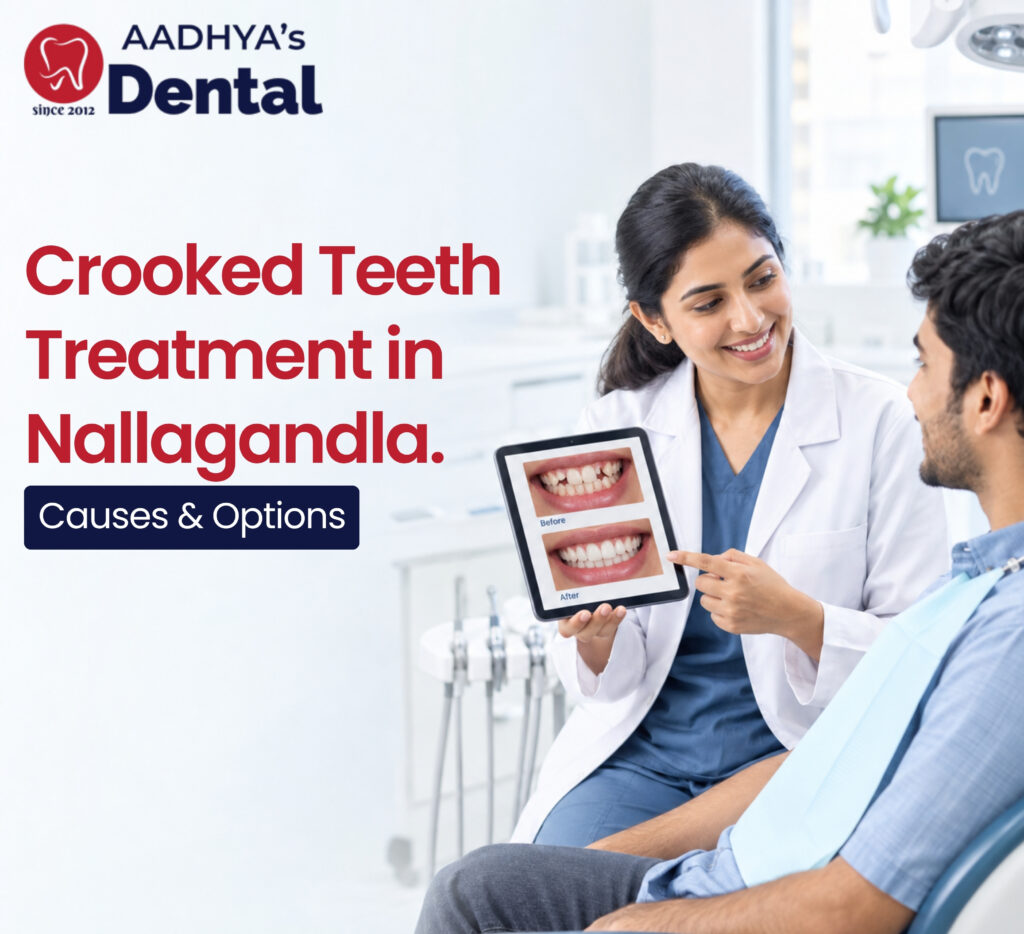
Crooked teeth are one of the most common dental concerns among children, teenagers and adults. For some people, crooked teeth are mainly a cosmetic concern. For others, crowded or misaligned teeth can make brushing and flossing difficult, affect the way the teeth come together, or contribute to bite-related problems.
The good news is that crooked teeth can often be treated with modern orthodontic options, depending on the cause and severity of the problem.
At Aadhya’s Dental, Nallagandla, crooked teeth are evaluated as part of the patient’s overall oral health rather than being treated as an isolated cosmetic concern. A comprehensive assessment helps determine why the teeth are misaligned and which treatment approach may be appropriate.
Whether you are a parent concerned about your child’s developing teeth or an adult considering braces or clear aligners in Nallagandla, understanding the causes and treatment options is an important first step.
For further information about choosing the perfect time for your dental visit, also read: https://aadhyasdental.com/choosing-the-perfect-time-for-your-dental-visit/
What Are Crooked Teeth?
Crooked teeth are teeth that are positioned, rotated, tilted or crowded in a way that differs from the ideal alignment.
Crooked teeth can appear as:
- Overlapping teeth
- Rotated teeth
- Teeth that tilt inward or outward
- Crowded front teeth
- Teeth positioned too far forward or backward
- Uneven spacing
- Teeth that do not fit properly with the opposing teeth
The appearance can range from mildly irregular to significantly crowded or misaligned.
Not every crooked tooth requires orthodontic treatment. The decision depends on factors such as bite, oral health, function, severity of crowding, gum health, age and the patient’s individual concerns.
What Causes Crooked Teeth?
There is usually no single reason why teeth become crooked. Several factors can contribute to tooth misalignment.
1. Genetics
Genetics can influence the size and shape of the jaws and teeth.
For example, a person may inherit relatively large teeth but have a smaller jaw, creating insufficient space for proper alignment.
Similarly, jaw size and facial growth patterns can influence how the upper and lower teeth come together.
Also Read : https://aadhyasdental.com/can-a-dentist-treat-my-jaw-pain/
2. Dental Crowding
Crowding occurs when there is not enough space for all the teeth to align properly.
Crowded teeth may overlap or rotate as they try to fit into the available space.
Crowding is particularly common in the lower front teeth and may become more noticeable as children grow into adolescence and adulthood.
If you notice crowded teeth in your child, an early dental or orthodontic evaluation can help determine whether monitoring or treatment is appropriate.
3. Early Loss of Baby Teeth
Baby teeth help maintain space for permanent teeth.
When a baby tooth is lost prematurely because of decay, trauma or another reason, neighbouring teeth can sometimes move into the available space.
This may reduce the space available for the permanent tooth and contribute to alignment problems.
This is one reason why maintaining good children’s dental health is important for long-term dental development.
4. Prolonged Thumb Sucking or Pacifier Use
Certain oral habits during childhood can influence developing teeth and jaws.
Prolonged thumb sucking or pacifier use may contribute to changes in tooth position or bite in some children.
The impact depends on factors such as duration, frequency and the child’s stage of development.
If you are concerned about your child’s oral habits, a pediatric dental or orthodontic assessment can help.
5. Mouth Breathing and Other Oral Habits
Persistent mouth breathing may sometimes be associated with changes in oral and facial development.
Tongue-thrusting habits and other abnormal oral behaviours can also influence tooth position in certain children.
If an underlying habit is contributing to an orthodontic problem, identifying it is important when planning treatment.
6. Missing or Extra Teeth
Missing teeth can allow neighbouring teeth to drift into the space.
Extra teeth can interfere with the normal eruption of permanent teeth.
Both situations can contribute to abnormal tooth positioning and may require a comprehensive dental assessment.
7. Jaw Development
Sometimes crooked teeth are not simply a tooth-position problem.
The relationship between the upper and lower jaws can also affect how the teeth align.
Problems such as an overbite, underbite or crossbite may involve both tooth position and jaw relationships.
This is why orthodontic treatment should be planned after evaluating the patient’s overall bite.
Can Teeth Become Crooked With Age?
Yes.
Many people notice that their teeth were relatively straight when they were younger but gradually became more crowded.
Teeth can naturally shift throughout life.
Changes may become particularly noticeable in the lower front teeth. Previous orthodontic treatment, changes in the supporting tissues, tooth loss and natural age-related movement can all influence tooth position.
If your teeth have recently started moving or becoming crowded, a dental examination can help determine the reason.
Are Crooked Teeth Only a Cosmetic Problem?
Not always.
For some people, crooked teeth have little impact beyond appearance.
However, significant crowding or misalignment can sometimes make it harder to:
- Brush effectively
- Floss between teeth
- Maintain healthy gums
- Clean areas between overlapping teeth
- Bite comfortably
- Chew efficiently
Certain types of malocclusion can also contribute to uneven tooth wear or other bite-related concerns.
Therefore, straightening crooked teeth is not necessarily only about improving your smile.
Problems That Can Be Associated With Crooked Teeth
Difficulty Maintaining Oral Hygiene
Overlapping and crowded teeth can create areas that are difficult to access with a toothbrush or floss.
Plaque accumulation in these areas can increase the risk of tooth decay and gum inflammation.
Gum Problems
When teeth are crowded or positioned unfavourably, maintaining good plaque control may become more challenging.
This can contribute to gingivitis and, in susceptible individuals, periodontal problems.
Uneven Tooth Wear
An abnormal bite can sometimes cause certain teeth to receive more pressure than others.
Over time, this may contribute to excessive or uneven tooth wear.
Bite Problems
Severely misaligned teeth may affect how the upper and lower teeth meet.
This can sometimes influence chewing or create other functional concerns.
Smile and Confidence
For many patients, crooked front teeth are primarily an aesthetic concern.
Feeling uncomfortable about the appearance of your smile can affect confidence in social or professional situations.
Orthodontic treatment can be considered when improving tooth alignment is important to the patient.
Can Crooked Teeth Be Straightened?
In many cases, yes.
Modern orthodontic treatment offers several options for improving tooth alignment.
The most appropriate treatment depends on:
- Severity of crowding
- Type of tooth movement required
- Bite relationship
- Age
- Gum and bone health
- Existing dental conditions
- Treatment goals
- Patient preferences
An orthodontic consultation is therefore important before choosing a treatment method.
Treatment Options for Crooked Teeth
1. Traditional Braces
Traditional braces use brackets and orthodontic wires to gradually move teeth into planned positions.
They can be used for a wide range of orthodontic problems and remain an important treatment option for children, teenagers and adults.
Braces may be particularly useful when significant or complex tooth movements are required.
2. Clear Aligners
Clear aligners, including Invisalign, use a series of transparent removable trays to gradually move teeth.
For suitable patients, they can provide a discreet alternative to traditional braces.
Clear aligners may be considered for certain cases involving:
- Mild to moderate crowding
- Spacing
- Selected bite problems
- Relapse after previous orthodontic treatment
- Certain alignment concerns
However, not every crooked-teeth case is suitable for clear aligners.
The type and severity of the tooth movement required must be evaluated before deciding whether aligner treatment is appropriate.
Patients searching for Invisalign in Nallagandla should therefore have a detailed assessment rather than choosing aligners solely based on convenience or appearance.
3. Orthodontic Treatment for Children
Children’s orthodontic treatment may differ from adult treatment because their jaws and permanent teeth are still developing.
In some cases, early evaluation allows the dental team to monitor growth and tooth eruption and identify the appropriate time for treatment.
Early assessment may be useful when a child has:
- Severe crowding
- Protruding teeth
- Crossbite
- Underbite
- Significant overbite
- Abnormal tooth eruption
- Persistent oral habits
Importantly, an early orthodontic consultation does not always mean that braces need to be placed immediately.
4. Orthodontic Treatment for Adults
It is never automatically “too late” to consider orthodontic treatment simply because you are an adult.
Adults may seek treatment for:
- Long-standing crooked teeth
- Teeth that have shifted after braces
- Crowding that has developed over time
- Gaps
- Bite problems
- Smile aesthetics
Before starting treatment, adult patients may need evaluation of their gums, teeth, existing restorations and overall oral health.
At Aadhya’s Dental, this comprehensive approach helps ensure that orthodontic treatment is considered in the context of the patient’s broader dental needs.
Braces vs Clear Aligners for Crooked Teeth
Patients often ask:
“Should I choose braces or Invisalign for crooked teeth?”
There is no universal answer.
Braces may be appropriate when:
- More extensive tooth movement is required
- The orthodontic problem is complex
- The patient may have difficulty consistently wearing removable aligners
Clear aligners may be appropriate when:
- The patient’s orthodontic problem is suitable for aligner treatment
- A discreet treatment option is preferred
- The patient can consistently wear the aligners as instructed
The choice should be based on the individual orthodontic diagnosis, not simply on which option looks more attractive.
A Comprehensive Approach at Aadhya’s Dental, Nallagandla
At Aadhya’s Dental, Nallagandla, the goal is not simply to make crooked teeth look straight.
A comprehensive evaluation may consider:
- Tooth alignment
- Bite relationship
- Jaw relationship
- Gum health
- Tooth decay
- Existing dental restorations
- Missing teeth
- Oral hygiene
- Age and growth
- Previous orthodontic treatment
- Lifestyle
- Patient expectations
This is especially important because two patients with apparently similar crooked teeth may have completely different underlying problems.
Patient-centred care with Dr Mrudula
Dr Mrudula follows a patient-centred approach, taking time to understand what the patient is concerned about and what they hope to achieve.
For a child, the priority may be healthy dental development and appropriate timing of treatment.
For an adult, the priorities may include aesthetics, convenience, treatment duration and compatibility with work or lifestyle.
The discussion is therefore individualised rather than based on a one-size-fits-all treatment plan.
Patients are encouraged to ask questions, understand their options and make informed decisions about their dental care.
When Should You See a Dentist or Orthodontic Professional for Crooked Teeth?
Consider an evaluation if:
- Your teeth are becoming increasingly crowded
- Your front teeth overlap significantly
- You have difficulty cleaning between certain teeth
- Your bite feels uneven
- Your upper and lower teeth do not meet comfortably
- Your child has noticeably crowded or protruding teeth
- Your teeth have shifted after previous braces
- You are unhappy with the appearance of your smile
- You are considering Invisalign or clear aligners
- You have concerns about your child’s tooth eruption
You do not have to wait until crooked teeth cause pain.
Many orthodontic problems do not cause obvious symptoms in the early stages.
Crooked Teeth Treatment in Nallagandla
If you are looking for treatment for crooked teeth in Nallagandla, a detailed evaluation is an important first step.
At Aadhya’s Dental, patients from Nallagandla and nearby areas such as Tellapur, Lingampally, Gachibowli, Gopanpally, BHEL, Miyapur and Kondapur can seek guidance for concerns involving crooked teeth, crowding, spacing, bite problems and orthodontic treatment.
Whether the concern involves a child whose permanent teeth are erupting irregularly or an adult looking for braces or Invisalign near Nallagandla, the treatment approach should be based on the patient’s individual dental condition.
Frequently Asked Questions About Crooked Teeth
1. Why do my teeth become crooked?
Crooked teeth can result from genetics, crowding, jaw development, early loss of baby teeth, oral habits, missing teeth and natural tooth movement over time.
The cause varies between individuals.
2. Can crooked teeth be straightened without braces?
In selected cases, clear aligners such as Invisalign can straighten teeth without traditional brackets and wires.
However, aligners are not suitable for every case. A professional assessment is needed to determine whether they are appropriate.
3. Is Invisalign good for crooked teeth?
Invisalign can be effective for certain types of crooked or crowded teeth. Its suitability depends on the complexity of the case and the movements required.
4. Can crooked teeth cause cavities?
Crooked or crowded teeth can make certain areas more difficult to clean. This may increase plaque accumulation and contribute to a higher risk of tooth decay if oral hygiene is inadequate.
5. Can crooked teeth cause gum disease?
Crowded teeth can make brushing and flossing more difficult. Poor plaque control may contribute to gum inflammation and periodontal problems.
However, gum disease has multiple risk factors and should be assessed individually.
6. Can adults fix crooked teeth?
Yes. Adults can undergo orthodontic treatment when their teeth and supporting tissues are suitable.
Depending on the case, treatment may involve traditional braces or clear aligners.
7. Can crooked teeth get worse with age?
Teeth can naturally shift over time. Some people experience increasing crowding, particularly in the lower front teeth.
A dental evaluation can help determine what is causing the change.
8. Does my child need braces if their teeth are crowded?
Not necessarily.
Some children may benefit from early treatment, while others may simply need monitoring until a more appropriate stage of dental development.
An evaluation can help determine the right timing.
9. How long does it take to straighten crooked teeth?
Treatment time varies according to the severity of crowding, type of tooth movement required, treatment method and patient compliance.
A personalised estimate can be provided after examination and treatment planning.
10. Are crooked teeth only a cosmetic problem?
No. Although appearance is an important concern for many patients, significant misalignment can sometimes affect oral hygiene, bite function and tooth wear.
11. Can teeth become crooked again after orthodontic treatment?
Yes. Teeth can shift after treatment, which is why retainers are generally an important part of maintaining orthodontic results.
12. Should I get braces or Invisalign?
The right option depends on your specific orthodontic problem.
A professional evaluation can determine whether braces, clear aligners or another approach is appropriate.
Conclusion
Crooked teeth are common, but the reasons behind them can be very different from one person to another. Genetics, crowding, childhood habits, early tooth loss, jaw development and natural tooth movement can all contribute to misalignment.
Treatment may involve traditional braces, clear aligners such as Invisalign, or other orthodontic approaches, depending on the individual case.
At Aadhya’s Dental, Nallagandla, the focus is on comprehensive evaluation and patient-centred care. Dr Mrudula takes time to understand each patient’s concerns and explain the available options, while considering tooth alignment, bite, gum health, oral hygiene, age and long-term dental health.
If you are concerned about crooked teeth, crowded teeth or bite problems, an orthodontic consultation can help you understand the cause and explore appropriate treatment options.
For patients in Nallagandla, Tellapur, Gachibowli, Lingampally, Gopanpally, BHEL, Miyapur and nearby areas, Aadhya’s Dental provides comprehensive dental care with a focus on individualised treatment planning and patient comfort.
Get expert crooked teeth treatment in Nallagandla at Aadhya’s Dental with Dr. Mrudula. Call +91-7396235802 to book your appointment today!