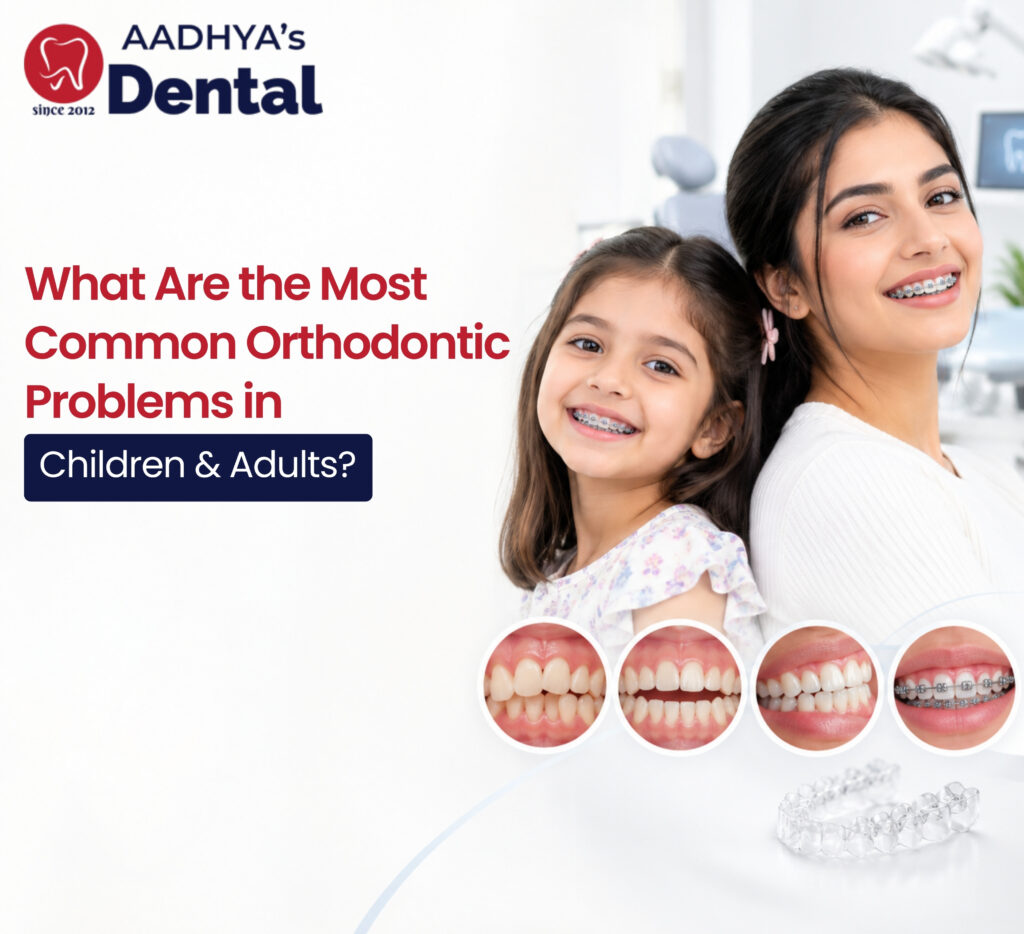
A straight smile is often associated with confidence, but orthodontics is about much more than appearance. The position of your teeth, the way your upper and lower teeth meet, jaw development, and the ability to maintain good oral hygiene can all be affected by orthodontic problems.
Crowded teeth, gaps, overbite, underbite, crossbite, open bite and protruding teeth are some of the common orthodontic concerns seen in children, teenagers and adults.
At Aadhya’s Dental, Nallagandla, orthodontic concerns are approached with a comprehensive, patient-centred philosophy. Rather than focusing only on straightening teeth, the dental team considers the patient’s overall oral health, bite, gum condition, tooth position, age, lifestyle and treatment expectations.
Dr Mrudula takes time to understand each patient’s concerns, explain the findings in simple terms and discuss suitable treatment options. This individualised approach helps patients make informed decisions about braces, clear aligners and other orthodontic treatment options.
If you are searching for an orthodontic consultation in Nallagandla, understanding common orthodontic problems is a good place to start.
Also Read : For further information about choosing the perfect time for your dental visit, also read: https://aadhyasdental.com/choosing-the-perfect-time-for-your-dental-visit/
What Are Orthodontic Problems?
Orthodontic problems occur when the teeth or jaws are not positioned or aligned ideally.
Some problems are mainly related to the position of individual teeth, while others involve the way the upper and lower jaws relate to each other.
Common orthodontic problems include:
- Crowded teeth
- Crooked teeth
- Gaps between teeth
- Overbite
- Underbite
- Crossbite
- Open bite
- Protruding teeth
- Abnormal tooth eruption
- Problems with the way the teeth come together
Some orthodontic problems are obvious when you look at the smile. Others may only become apparent during a dental examination.
This is why an orthodontic evaluation can be useful even when the problem does not appear severe.
1. Crowded Teeth
Dental crowding is one of the most common orthodontic problems.
Crowding occurs when there is insufficient space for the teeth to align properly. Teeth may overlap, rotate or erupt in unusual positions.
Crowded teeth can sometimes make brushing and flossing more difficult. Areas that are difficult to clean may allow plaque to accumulate, increasing the risk of tooth decay and gum problems.
Why does crowding happen?
Possible factors include:
- Differences between tooth and jaw size
- Genetics
- Early loss of baby teeth
- Abnormal tooth eruption
- Certain childhood habits
- Changes in tooth position over time
The treatment required depends on the severity and underlying cause.
For patients considering braces in Nallagandla, an examination is important before deciding which orthodontic option is appropriate.
2. Crooked Teeth
Crooked or rotated teeth can affect both children and adults.
Some patients have had crooked teeth since their permanent teeth erupted, while others notice increasing irregularity as they grow older.
Crooked teeth may be a cosmetic concern, but they can also create areas that are harder to clean.
Depending on the case, crooked teeth may be treated with traditional braces or clear aligners such as Invisalign.
However, clear aligners are not automatically suitable for every patient. Treatment should be selected after evaluating the type and severity of tooth movement required.
Also Read : https://aadhyasdental.com/crooked-teeth-treatment-in-nallagandla-causes-options/
3. Gaps Between Teeth
Spaces between teeth are another common orthodontic concern.
A gap may occur because of:
- Tooth size and jaw size differences
- Missing teeth
- Naturally spaced teeth
- Certain oral habits
- Gum-related problems
- Other developmental factors
A gap between the upper front teeth is often called a diastema.
Some spaces are completely normal and may not require treatment. Others may benefit from orthodontic correction.
If you are looking for clear aligners near Nallagandla or Tellapur to close gaps between teeth, an assessment can help determine whether aligner treatment is appropriate.
4. Overbite
An overbite refers to the overlap of the upper front teeth over the lower front teeth.
A certain degree of overlap is normal. However, an excessive or deep overbite can sometimes contribute to:
- Tooth wear
- Gum irritation
- Bite discomfort
- Difficulty in certain oral functions
Treatment depends on the cause and severity of the overbite.
An orthodontic evaluation can determine whether the problem is primarily related to tooth position, jaw relationship, or both.
5. Underbite
An underbite occurs when the lower front teeth are positioned ahead of the upper front teeth when the mouth is closed.
Underbites can have different causes. In some patients, the position of the teeth is the primary concern, while in others the jaw relationship plays a significant role.
For growing children, early assessment can sometimes be particularly useful because the developing jaws can influence treatment planning.
Adults with significant jaw-related discrepancies may require a more specialised evaluation.
6. Crossbite
A crossbite occurs when one or more teeth bite in an abnormal relationship with the opposing teeth.
Crossbite can involve the front teeth, back teeth or both.
In children, certain crossbites may benefit from timely evaluation because the child’s developing bite and jaws can influence the treatment approach.
Parents who notice that their child’s teeth appear to bite “inside out” or unevenly should consider discussing the concern with a dentist or orthodontic professional.
7. Open Bite
An open bite occurs when certain upper and lower teeth do not contact each other when the mouth is closed.
An open bite may be associated with:
- Thumb sucking
- Tongue-thrusting habits
- Mouth breathing
- Tooth positioning
- Jaw development patterns
Simply moving the teeth may not always address the underlying cause. A comprehensive assessment is therefore important.
At Aadhya’s Dental, Nallagandla, the focus is on understanding the factors contributing to the patient’s bite problem before discussing treatment.
8. Protruding Front Teeth
Some children and adults have upper front teeth that appear significantly forward.
Protruding teeth can affect the appearance of the smile and, in some cases, may be more vulnerable to accidental trauma.
The cause may be related to tooth position, jaw development, or a combination of factors.
An orthodontic consultation can help determine what is contributing to the appearance and whether treatment is recommended.
9. Problems With Tooth Eruption
Sometimes permanent teeth do not erupt in the expected position or do not emerge when anticipated.
This may occur because of:
- Lack of space
- Crowding
- Retained baby teeth
- Abnormal tooth position
- Other developmental factors
Parents should discuss significant delays or unusual eruption patterns with their child’s dentist.
Early identification can sometimes make treatment planning easier.
Why Are Orthodontic Problems Important in Children?
Parents often ask:
“When should my child have an orthodontic evaluation?”
There is no single age at which every child needs braces.
However, an orthodontic assessment can help identify developing problems such as:
- Severe crowding
- Crossbite
- Underbite
- Excessive overbite
- Protruding teeth
- Abnormal eruption
- Jaw development concerns
- Effects of prolonged oral habits
Importantly, an early consultation does not necessarily mean immediate braces.
For some children, the best approach may be to monitor dental development and begin treatment at an appropriate stage.
This is an important part of a comprehensive approach to children’s orthodontic care in Nallagandla.
Orthodontic Problems in Adults
Orthodontic treatment is not only for children and teenagers.
Adults may seek treatment because of:
- Crooked teeth
- Crowding
- Gaps
- Overbite
- Underbite
- Teeth that shifted after previous braces
- Difficulty cleaning certain areas
- Bite concerns
- Smile-related concerns
Teeth can naturally move throughout life, which means that someone who had relatively straight teeth when younger may develop crowding later.
Adults may also have other dental considerations such as fillings, crowns, missing teeth, gum disease or worn teeth.
For this reason, adult orthodontic treatment should begin with a comprehensive dental assessment.
Can Crooked Teeth Affect Oral Health?
In some patients, yes.
Crowded or rotated teeth can make brushing and flossing more challenging. When plaque repeatedly remains around difficult-to-clean areas, it can contribute to:
- Tooth decay
- Gum inflammation
- Bad breath
- Gum disease
However, orthodontic treatment is not simply about preventing these problems.
A well-planned treatment may also improve the relationship between the teeth, support better oral hygiene and address certain functional bite concerns.
Braces or Clear Aligners: Which Is Better?
Patients often ask whether they should choose braces or Invisalign.
The answer depends on the individual case.
Traditional braces
Braces use brackets and orthodontic wires to gradually move teeth.
They remain an effective option for many orthodontic problems and can be used in children, teenagers and adults.
Clear aligners
Clear aligners are transparent, removable trays designed to gradually move teeth.
They can be an appealing option for selected patients who prefer a more discreet treatment.
However, not every orthodontic problem can be managed in exactly the same way with aligners.
The choice between braces and clear aligners should be based on:
- Type of orthodontic problem
- Severity of the problem
- Required tooth movements
- Bite relationship
- Age
- Oral health
- Patient compliance
- Treatment expectations
At Aadhya’s Dental, the emphasis is on selecting an appropriate treatment plan rather than recommending one treatment option for everyone.
A Patient-Centered Approach to Orthodontic Care at Aadhya’s Dental
Orthodontic treatment is a journey that can take several months or longer. Patients should therefore understand what is being treated, why treatment is recommended and what they can expect.
At Aadhya’s Dental, Nallagandla, Dr Mrudula follows a patient-centred approach.
This means the consultation starts with understanding the patient’s concerns.
Whether a parent is worried about a child’s crowded teeth or an adult is looking for Invisalign in Nallagandla, the discussion focuses on the individual rather than using a one-size-fits-all approach.
Dr Mrudula takes time to:
- Listen to the patient’s concerns
- Assess the teeth and bite
- Understand relevant dental history
- Consider gum and overall oral health
- Explain the findings clearly
- Discuss appropriate treatment options
- Address questions and concerns
- Help the patient understand the expected treatment journey
The aim is to make orthodontic treatment a more informed and comfortable experience.
A Comprehensive Approach to Dental and Orthodontic Care
At Aadhya’s Dental, orthodontic concerns are considered as part of the patient’s overall oral health.
Before orthodontic treatment, factors such as gum health, cavities, existing dental restorations, missing teeth, oral hygiene and bite relationships may need to be evaluated.
This comprehensive approach is particularly important because a patient’s orthodontic needs may be connected with other dental conditions.
For example, a patient with crowded teeth and gum inflammation may need appropriate gum care and oral hygiene guidance alongside orthodontic planning.
Similarly, an adult considering clear aligners may need existing dental concerns addressed before starting orthodontic treatment.
The goal is to create a treatment plan that considers the patient’s long-term oral health, not just the appearance of the teeth during treatment.
When Should You Consider an Orthodontic Consultation?
You may consider an orthodontic consultation if you or your child has:
- Crowded or overlapping teeth
- Large spaces between teeth
- Protruding front teeth
- An obvious overbite
- Underbite
- Crossbite
- Open bite
- Difficulty biting or chewing
- Teeth that are difficult to clean
- Abnormal tooth eruption
- Teeth shifting after previous braces
- Concerns about smile alignment
You do not necessarily need to wait until an orthodontic problem becomes severe.
An evaluation can help determine whether treatment is necessary, whether monitoring is sufficient, and what options may be available.
Orthodontic Treatment in Nallagandla
If you are searching for orthodontic treatment in Nallagandla, braces in Nallagandla, or clear aligners near Nallagandla, it is important to look beyond treatment cost or appearance alone.
The quality of the initial assessment and treatment planning can influence the overall treatment experience.
At Aadhya’s Dental, Nallagandla, the approach combines comprehensive dental evaluation with patient-focused communication.
Patients from nearby areas such as Tellapur, Lingampally, Gachibowli, Gopanpally, BHEL, Miyapur and Kondapur can consult the clinic for concerns related to crooked teeth, crowded teeth, gaps, bite problems, braces and clear aligners.
Frequently Asked Questions About Orthodontic Problems
1. What are the most common orthodontic problems?
Common orthodontic problems include crowded teeth, crooked teeth, gaps, overbite, underbite, crossbite, open bite and protruding teeth.
The severity and cause of each problem can vary from person to person.
2. What is the right age for an orthodontic consultation?
Children can benefit from an orthodontic assessment when there are concerns about tooth alignment, bite, eruption or jaw development. Treatment does not necessarily have to begin immediately.
Adults can also seek orthodontic evaluation at any age when their teeth and supporting tissues are suitable for treatment.
3. Do crooked teeth always need braces?
No. Not every crooked tooth requires orthodontic treatment.
The decision depends on the severity of the alignment problem, bite, oral health, function, aesthetics and the patient’s individual goals.
4. Can adults get braces?
Yes. Adults can receive orthodontic treatment if their teeth and supporting tissues are healthy enough for the planned treatment.
Depending on the case, options may include traditional braces or clear aligners.
5. Can Invisalign fix crowded teeth?
Clear aligners can correct certain types and degrees of dental crowding. However, their suitability depends on the individual case and the tooth movements required.
An assessment is necessary before determining whether Invisalign is appropriate.
6. Can braces fix an overbite?
Braces can correct many types of overbite. However, treatment depends on whether the problem is primarily related to tooth position, jaw relationship or both.
7. Can orthodontic treatment close gaps between teeth?
Yes, orthodontic treatment can close many types of dental spaces. However, the cause of the gap should be identified before treatment begins.
8. Can crooked teeth cause gum problems?
Crooked and crowded teeth can make some areas more difficult to clean. Poor plaque control can contribute to gum inflammation and other oral health problems.
Good oral hygiene and regular dental care are particularly important during orthodontic treatment.
9. Does my child need braces immediately if their teeth are crowded?
Not necessarily.
Some children benefit from early treatment, while others may be better monitored until a more appropriate stage of dental development.
A professional assessment can help determine the timing.
10. Can teeth become crooked again after braces?
Teeth can shift after orthodontic treatment. Retainers are generally used to help maintain the corrected positions.
Following the recommended retention plan is an important part of long-term orthodontic care.
11. Are clear aligners better than braces?
Neither option is universally better.
Clear aligners may be convenient and discreet for suitable patients, while braces can be appropriate for a wide range of orthodontic movements.
The best choice depends on the individual patient’s orthodontic condition.
12. How long does orthodontic treatment take?
Treatment duration varies considerably depending on the complexity of the case, the type of treatment, the required tooth movements and patient compliance.
A personalised estimate can be provided after evaluation and treatment planning.
Conclusion
Orthodontic problems can affect children, teenagers and adults, and they are not limited to crooked teeth. Crowding, spacing, overbite, underbite, crossbite, open bite and abnormal tooth eruption can all require different approaches.
The most important step is understanding why the problem exists and whether treatment is actually needed.
At Aadhya’s Dental, Nallagandla, Dr Mrudula follows a patient-centred and comprehensive approach, taking into consideration the patient’s dental health, bite, gum condition, age, lifestyle, concerns and treatment goals.
Whether you are a parent concerned about your child’s developing teeth or an adult exploring braces or Invisalign in Nallagandla, a detailed consultation can help you understand your options and make an informed decision about your oral health.
A healthy, functional smile is not just about straight teeth—it is about creating a treatment plan that works for the individual patient.
Book Your Appointment Today!
Website:https://aadhyasdental.com/
Address: Aadhya’s Dental | Best Dental Clinic in Nallagandla
Phone: +91-73962 35802