
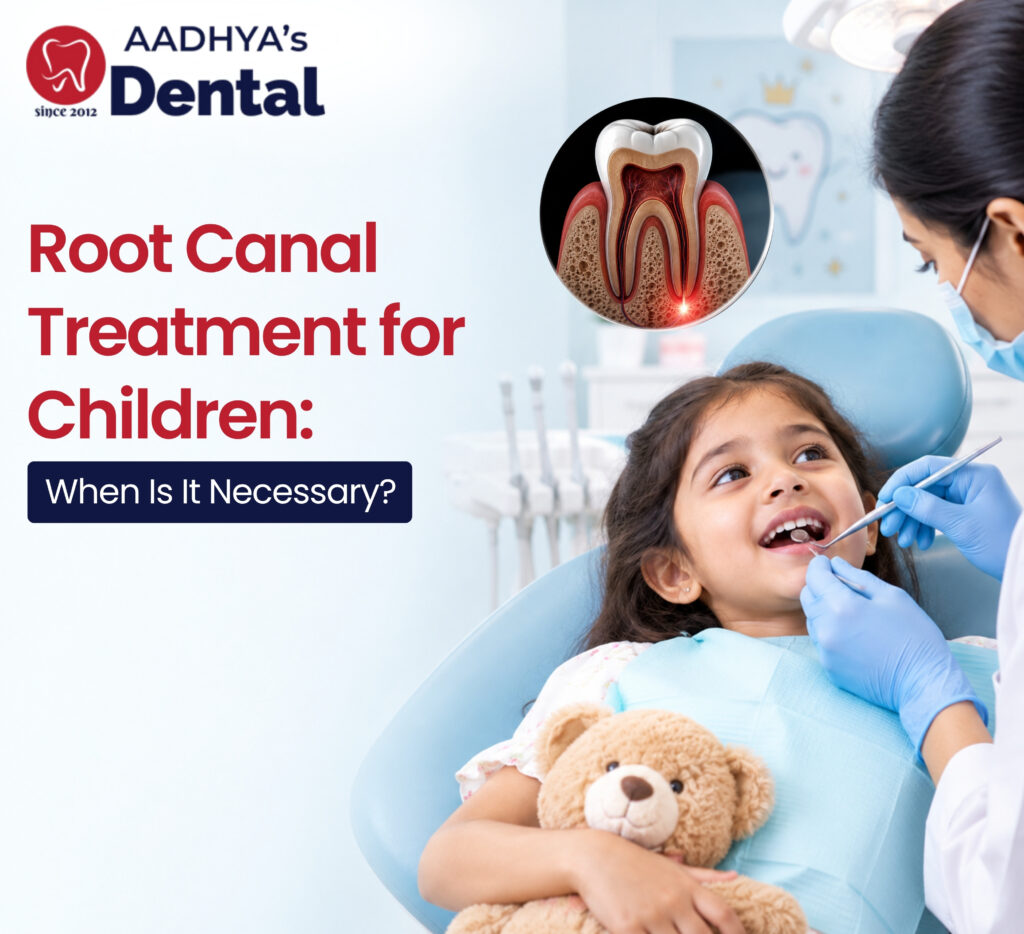
A child’s dental health plays an important role in their overall health, comfort, and development. While baby teeth eventually fall out, they are still important for chewing, speaking, maintaining space for permanent teeth, and supporting healthy jaw development. When a child has a severely damaged or infected tooth, root canal treatment for children may sometimes be recommended to save the tooth and prevent further dental problems.
Many parents feel worried when they hear the words “root canal” in relation to their child. However, modern pediatric dental procedures are designed to make treatment as comfortable and safe as possible. Depending on the condition of the tooth, a dentist may recommend a procedure such as a pulpotomy or pulpectomy to remove infected tissue and preserve the tooth.
At Aadhya Dental Clinic, children can receive professional dental evaluation and treatment based on their individual dental needs.
What Is Root Canal Treatment for Children?
Root canal treatment is a dental procedure used when the inner part of a tooth, called the pulp, becomes inflamed or infected. The pulp contains nerves and blood vessels. Deep tooth decay, trauma, or other dental problems can allow bacteria to reach the pulp.
In children, treatment may differ depending on whether the affected tooth is a baby tooth or a permanent tooth. For baby teeth, dentists may perform a pulpotomy when the infection is limited to part of the pulp. If the infection has affected the entire pulp, a pulpectomy may be considered.
The main goal is to remove infected tissue, control the infection, and preserve the tooth until it is naturally ready to fall out.
Why Do Children Need Root Canal Treatment?
Children can develop tooth infections for several reasons. One of the most common causes is untreated tooth decay.
Some common causes include:
- Deep cavities
- Tooth infection
- Cracked or fractured teeth
- Dental trauma or injury
- Repeated dental procedures on the same tooth
- Untreated decay reaching the tooth pulp
- Bacterial infection inside the tooth
Children may not always explain dental pain clearly. Some may simply avoid eating, become irritable, or complain about discomfort while chewing.
Regular dental checkups can help identify cavities and other problems before they become severe.
For further information about how to prepare for your first visit to a dental clinic Also Read : https://aadhyasdental.com/how-to-prepare-for-your-first-visit-to-a-dental-clinic/
Signs That Your Child May Need Root Canal Treatment
Parents should pay attention to changes in their child’s teeth and behavior. Some symptoms may indicate that the tooth needs professional evaluation.
1. Persistent Toothache
A child who repeatedly complains of tooth pain, especially without an obvious reason, should have the tooth examined by a dentist.
2. Pain While Eating
Pain when chewing or biting may indicate that the tooth has significant decay or inflammation.
3. Sensitivity to Hot or Cold
If your child experiences prolonged discomfort after consuming hot or cold foods and drinks, the pulp may be affected.
4. Swelling Around the Tooth
Swelling in the gums near a tooth can be a sign of infection. Facial swelling may require prompt dental attention.
5. Dental Abscess
A small pimple-like bump on the gum near a tooth may sometimes indicate an abscess. This should be evaluated by a dentist.
6. Tooth Discoloration
A tooth that becomes grey, brown, or darker than the surrounding teeth may have experienced internal damage, particularly after an injury.
7. Difficulty Sleeping
Severe tooth pain can become more noticeable at night and may interfere with a child’s sleep.
Does Every Child With a Cavity Need a Root Canal?
No. Not every cavity requires root canal treatment.
The treatment depends on how deep the decay is and whether the dental pulp has been affected. A small or moderate cavity may be treated with a filling. If decay has reached the pulp and caused significant inflammation or infection, pulp therapy may be necessary.
A dentist usually examines the tooth and may recommend dental X-rays to understand the extent of the problem.
Early treatment can sometimes prevent a cavity from progressing to a more complicated infection.
How Is Root Canal Treatment Performed in Children?
The exact procedure depends on the child’s tooth and the extent of infection.
Generally, the dentist will:
- Examine the affected tooth.
- Take an X-ray when necessary.
- Use appropriate methods to keep the treatment area clean and comfortable.
- Remove the infected or damaged pulp tissue.
- Clean and disinfect the inside of the tooth.
- Fill the treated area with a suitable dental material.
7.Restore the tooth so it can continue functioning properly.
For baby teeth, the dentist may recommend a stainless-steel crown after pulp therapy, especially when the tooth has significant structural damage. This can help protect the remaining tooth structure.
Is Root Canal Treatment Painful for Children?
Parents often worry that root canal treatment will be painful. During treatment, the dentist uses local anesthesia to numb the area and help keep the child comfortable.
Some mild soreness or sensitivity may occur after the procedure. The dentist can provide appropriate aftercare instructions depending on the child’s age and treatment.
A calm dental environment and child-friendly communication can also help reduce anxiety.
For further information about Is It Okay to avoid a Root Canal Treatment visit, also read: https://aadhyasdental.com/is-it-okay-to-avoid-a-root-canal-treatment/
Why Is Saving a Baby Tooth Important?
Some parents may wonder why an infected baby tooth should be treated when it will eventually fall out.
Baby teeth have several important functions. They help children:
- Chew food properly
- Develop clear speech
- Maintain space for permanent teeth
- Support normal jaw development
- Become comfortable with healthy oral habits
Removing a baby tooth too early can sometimes cause neighboring teeth to move into the space intended for a permanent tooth. Depending on the child’s age and the tooth involved, this may affect the eruption of the permanent tooth.
Therefore, when possible and appropriate, dentists may recommend preserving the baby tooth until its natural time to fall out.
What Happens If an Infected Tooth Is Not Treated?
An untreated dental infection may become more serious over time. The infection can spread into surrounding tissues and cause swelling, pain, or an abscess.
In children, untreated dental problems can also affect eating, sleeping, school activities, and general comfort.
If your child has persistent tooth pain, swelling, fever associated with dental symptoms, or difficulty eating, seek professional dental care promptly.
Root Canal Treatment vs Tooth Extraction
Depending on the condition of the tooth, a dentist may recommend either pulp therapy or extraction.
Saving the natural tooth may be preferred when the tooth can be restored and is expected to remain in the mouth for an appropriate period. However, extraction may be considered when the tooth is severely damaged, cannot be restored, or there are other clinical reasons.
The dentist will consider factors such as the child’s age, the affected tooth, the condition of the permanent tooth underneath, and the extent of infection before recommending treatment.
How Can Parents Prevent Tooth Infections in Children?
Good daily oral hygiene can reduce the risk of cavities and infections.
Parents can encourage children to:
- Brush twice a day with fluoride toothpaste as recommended by their dentist.
- Limit frequent sugary snacks and drinks.
- Encourage water between meals.
- Avoid putting children to bed with sugary drinks.
- Visit the dentist regularly.
- Treat cavities at an early stage.
- Wear appropriate mouth protection during sports activities.
- Tell a dentist about any dental injury, even if the tooth initially appears normal.
Teaching children good oral hygiene from an early age can help them develop habits that continue into adulthood.
When Should You Take Your Child to a Dentist?
A child should not wait until they have severe pain before visiting a dentist. Regular dental checkups allow the dentist to identify cavities, enamel problems, gum issues, and other concerns early.
You should arrange a dental examination if your child has persistent toothache, sensitivity, swelling, a damaged tooth, discoloration, pain while chewing, or difficulty sleeping because of dental discomfort.
At Aadhya Dental Clinic, children can be evaluated to determine the cause of their dental symptoms and whether treatment such as a filling, pulp therapy, or another procedure is appropriate.
Final Thoughts
Root canal treatment for children may be necessary when tooth decay, injury, or infection reaches the inner part of the tooth. Treating the problem early can help control infection, relieve discomfort, and preserve the affected tooth when possible.
Baby teeth are important for chewing, speech, jaw development, and maintaining space for permanent teeth. For this reason, parents should not ignore persistent tooth pain or swelling simply because a tooth is expected to fall out eventually.
If your child is experiencing tooth pain, sensitivity, swelling, or other dental concerns, a professional examination can help determine the right treatment. Aadhya Dental Clinic can provide a dental evaluation and discuss suitable treatment options based on your child’s individual needs.
Frequently Asked Questions
1. Can children really need a root canal?
Yes. Children can need pulp therapy or root canal-type treatment when deep decay, trauma, or infection affects the pulp of a tooth. The dentist will determine the appropriate procedure based on the child’s tooth and condition.
2. Is root canal treatment safe for children?
Pulp therapy and root canal procedures can be performed in children when clinically necessary. The dentist will assess the child’s age, tooth development, infection, and overall dental condition before recommending treatment.
3. How do I know if my child has an infected tooth?
Common signs can include persistent toothache, pain while chewing, sensitivity, swelling around the gums, a gum abscess, tooth discoloration, or difficulty sleeping because of dental pain. Some infections may have few obvious symptoms, so regular dental examinations are important.
4. Can a baby tooth be saved instead of extracted?
In many cases, a baby tooth can be preserved if it is restorable and expected to remain in the mouth for an appropriate period. Pulp therapy may be considered when the pulp is affected. The dentist will recommend the most suitable option after examination.
5. How can I prevent my child from needing a root canal?
Regular brushing with fluoride toothpaste, limiting sugary foods and drinks, maintaining regular dental checkups, treating cavities early, and protecting teeth during sports can reduce the risk of severe tooth decay and dental infection.