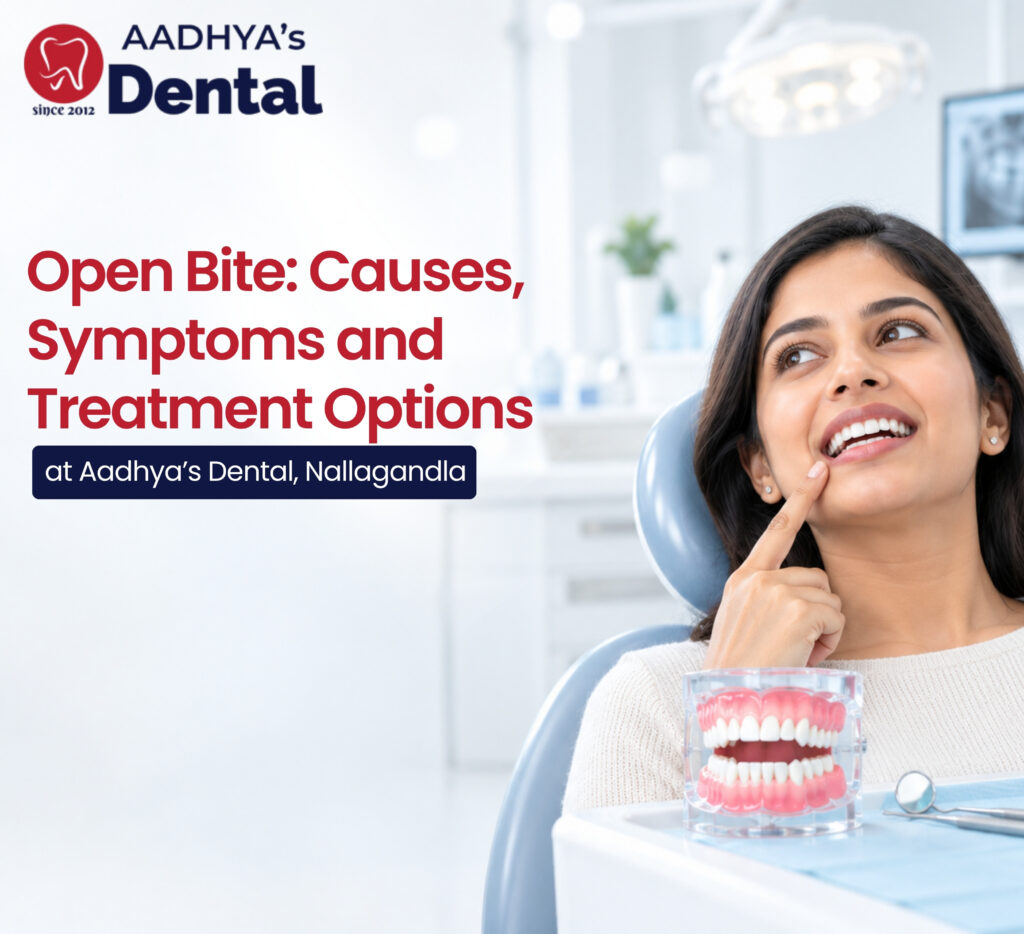
An open bite is a type of dental malocclusion in which some of the upper and lower teeth do not meet properly when the mouth is closed. You may notice a visible gap between the front or back teeth even when you bring your jaws together.
Apart from affecting the appearance of the smile, an open bite can sometimes make biting, chewing and speaking more difficult. In children, certain oral habits can contribute to the development of an open bite, while in adults, skeletal factors, tooth position, tongue posture and other causes may be involved.
If you or your child has an open bite, getting it evaluated early can help determine whether orthodontic treatment, habit correction or another approach is appropriate.
At Aadhya’s Dental, Nallagandla, patients can receive comprehensive dental and orthodontic evaluation for bite problems, including open bite, crowded teeth, crooked teeth and other malocclusions.
What Is an Open Bite?
Normally, when you close your mouth, the upper and lower teeth come together in a coordinated way.
With an open bite, certain teeth remain separated when the jaws are closed.
An open bite can broadly be classified as:
Anterior Open Bite
An anterior open bite occurs when the front upper and lower teeth do not touch when the back teeth are closed together.
This is the type of open bite most people notice when looking in the mirror.
Posterior Open Bite
A posterior open bite occurs when some of the back teeth fail to contact properly when the mouth is closed.
Posterior open bites are less common and may have different underlying causes.
What Causes an Open Bite?
There isn’t always one single reason for an open bite. Several factors can contribute.
1. Thumb Sucking and Pacifier Habits
Prolonged thumb sucking or certain pacifier habits during childhood can influence the position of the developing teeth and jaws.
If these habits continue beyond the period when they are developmentally appropriate, they may contribute to an anterior open bite.
2. Tongue Thrusting
The tongue plays an important role in the development and function of the mouth.
In some children and adults, the tongue may rest or move forward between the teeth during swallowing. Persistent tongue-thrusting patterns can contribute to or maintain an open bite in certain individuals.
3. Skeletal Growth Pattern
The way the upper and lower jaws grow can influence the development of an open bite.
Some patients have a skeletal pattern that makes an open bite more likely. In these situations, treatment planning may need to consider both the teeth and the underlying jaw relationship.
4. Dental Position
Sometimes an open bite is primarily related to the position or eruption of individual teeth.
Orthodontic treatment may be used to gradually move the teeth into a more functional relationship.
5. Genetics
Jaw size, facial growth pattern and tooth characteristics can have a genetic component. A family history of certain bite problems may therefore increase the likelihood of developing malocclusion.
6. Oral Habits
Other repetitive oral habits may influence dental development, particularly when they occur frequently during childhood.
Identifying the habit and addressing it appropriately can be an important part of treatment.
What Are the Symptoms of an Open Bite?
An open bite may be obvious, but some people have relatively mild symptoms.
Possible signs include:
- A visible gap between the upper and lower teeth
- Difficulty biting into foods such as apples or sandwiches
- Difficulty chewing certain foods
- Speech changes in some individuals
- Tongue appearing between the teeth while speaking or swallowing
- Difficulty closing the lips comfortably in some cases
- Uneven tooth wear
- Concerns about the appearance of the smile
Not every person with an open bite experiences all of these symptoms.
Can an Open Bite Affect Chewing?
Yes. The teeth are designed to work together during biting and chewing.
When some teeth do not meet properly, the chewing forces may not be distributed as efficiently. Depending on the severity and type of open bite, a person may find it harder to bite through or chew certain foods.
This is one reason why an open bite is not simply a cosmetic concern.
Can an Open Bite Affect Speech?
In some patients, an open bite may be associated with speech difficulties, particularly when the position of the tongue and front teeth affects the production of certain sounds.
However, speech problems can have many causes. A dental or orthodontic assessment can help determine whether the bite is contributing to the issue.
Open Bite in Children
Early evaluation can be particularly useful when an open bite is noticed in a growing child.
If a child continues thumb sucking, tongue thrusting or another oral habit, simply moving the teeth without addressing the underlying habit may not provide a stable long-term solution.
For this reason, treatment may involve:
- Identifying the underlying habit
- Counselling the child and parents
- Habit correction
- Monitoring facial and dental growth
- Orthodontic treatment when appropriate
Parents in Nallagandla, Tellapur, Lingampally, Gopanpally and nearby areas can consult a dentist or orthodontic provider if they notice that their child’s front teeth are not meeting normally.
Open Bite in Adults
Adults can also develop or continue to have an open bite.
Adult open bite treatment may be more complex depending on the cause and severity.
Factors considered during assessment can include:
- Tooth position
- Jaw relationship
- Tongue posture
- Previous orthodontic treatment
- Oral habits
- Severity of the open bite
- Overall dental health
Depending on the individual case, treatment may involve orthodontic correction or referral for additional specialist evaluation.
How Is an Open Bite Diagnosed?
Diagnosis begins with a detailed dental and orthodontic examination.
The dentist may assess:
- How the upper and lower teeth meet
- The size and location of the open bite
- Tooth position
- Jaw relationship
- Facial growth pattern
- Tongue posture
- Swallowing pattern
- Oral habits
- Overall oral health
Dental photographs, X-rays, digital scans or other diagnostic records may be recommended when necessary for treatment planning.
The aim is to determine why the open bite has developed and what type of treatment is most appropriate.
Open Bite Treatment Options
Treatment depends on the patient’s age, cause, severity and whether the problem is primarily dental or skeletal.
1. Habit Correction
For children with an open bite associated with thumb sucking, pacifier use or other oral habits, correcting the underlying habit may be an important first step.
Early intervention can sometimes reduce the influence of the habit on developing teeth and jaws.
2. Orthodontic Treatment
Braces or other orthodontic appliances may be used to correct the position of the teeth.
Treatment aims to improve:
- Tooth alignment
- Bite relationship
- Chewing function
- Smile aesthetics
The exact orthodontic approach depends on the patient’s individual bite.
3. Clear Aligners
In selected cases, clear aligners may be considered for open bite correction.
Aligners are removable, discreet orthodontic appliances that gradually move the teeth according to a carefully planned treatment sequence.
However, clear aligners are not automatically suitable for every open bite. The complexity of the case, tooth movement required and skeletal relationship all need to be considered.
Patients searching for clear aligners for open bite near Nallagandla or Tellapur should first undergo a professional assessment to determine whether aligner treatment is appropriate.
4. Growth Modification in Children
In growing children, certain orthodontic approaches may be used to influence dental development and, in selected situations, jaw growth.
The appropriate timing depends on the child’s individual growth pattern and the cause of the open bite.
5. Multidisciplinary Treatment
Some open bites are influenced by more than one factor.
For example, a patient may have an open bite together with tongue-thrusting behaviour and a particular jaw growth pattern.
Such cases may require coordinated care involving orthodontic treatment and management of the contributing functional factors.
6. Surgical Treatment for Selected Severe Skeletal Cases
In adults with a significant skeletal open bite, orthodontic tooth movement alone may not be sufficient.
In carefully selected severe skeletal cases, orthognathic jaw surgery may be considered as part of comprehensive treatment.
This does not mean that every open bite requires surgery. Most treatment decisions depend on the severity, underlying cause and functional impact of the condition.
Why Early Open Bite Evaluation Can Help
An open bite is easier to understand when the underlying cause is identified.
For children, early assessment may be particularly useful when there are persistent oral habits or noticeable bite changes.
For adults, evaluation can help distinguish between a primarily dental problem and a more significant skeletal issue.
Early professional guidance also helps prevent people from choosing an orthodontic treatment simply because it is convenient or aesthetically appealing without first understanding whether it is suitable for their specific bite.
Open Bite Treatment at Aadhya’s Dental, Nallagandla
At Aadhya’s Dental, Nallagandla, the approach to bite correction begins with understanding the individual patient rather than treating every open bite in exactly the same way.
A detailed assessment can help identify whether the problem is related primarily to tooth position, oral habits, tongue function, jaw development or a combination of factors.
For children, early dental guidance and habit-related counselling may be particularly important.
For teenagers and adults, orthodontic treatment options such as braces or clear aligners/Invisalign may be considered when clinically appropriate.
The treatment plan is based on the patient’s dental condition, age, expectations and long-term oral health.
Open Bite Treatment Near Tellapur, Gachibowli and Surrounding Areas
Aadhya’s Dental in Nallagandla is conveniently located for patients looking for dental and orthodontic care from nearby areas including:
- Nallagandla
- Tellapur
- Gopanpally
- Lingampally
- BHEL
- Miyapur
- Kondapur
- Financial District
- Vattinagulapally
- Gachibowli
- Narsingi
- Hitech City
If you are searching online for an open bite dentist near Tellapur, orthodontic treatment in Nallagandla, open bite treatment near Gachibowli, or clear aligners near Nallagandla, a proper clinical evaluation should be the first step.
Frequently Asked Questions About Open Bite
Is an open bite a serious dental problem?
It depends on its severity and cause. Some mild open bites may have limited functional impact, while more significant cases can affect chewing, speech or overall bite function.
Can an open bite correct itself?
In some young children, an open bite associated with a temporary oral habit may improve after the habit stops. However, persistent open bites should be evaluated rather than assuming they will correct themselves.
Can thumb sucking cause an open bite?
Prolonged thumb sucking can influence the developing teeth and jaws and may contribute to an anterior open bite in some children.
Can tongue thrust cause an open bite?
A persistent forward tongue posture or tongue-thrusting pattern can contribute to or maintain an open bite in some patients. Assessment of the underlying cause is important.
Can clear aligners fix an open bite?
Clear aligners can correct certain types of open bite, but suitability depends on the complexity of the case and whether the problem is primarily dental or skeletal.
Is open bite treatment possible in adults?
Yes. Adults can be treated for open bite, although the treatment approach depends on the underlying cause and severity.
Does an open bite affect chewing?
It can. When some teeth do not meet properly, biting and chewing efficiency may be affected, particularly in more pronounced cases.
Does an open bite affect speech?
It can contribute to certain speech difficulties in some patients, although speech problems can have many different causes.
Does every open bite need braces?
No. Treatment depends on the cause and severity. Some children may initially benefit from habit correction and monitoring, while others may require orthodontic treatment.
When should my child be evaluated for an open bite?
If you notice that your child’s front teeth do not meet, the tongue frequently rests between the teeth, or a thumb-sucking or other oral habit continues, a dental evaluation can help determine whether monitoring or early intervention is appropriate.
Conclusion
An open bite is more than just a gap between teeth. Depending on its cause and severity, it can influence chewing, speech, tooth function and the appearance of the smile.
The good news is that many open bite problems can be managed with appropriate treatment planning. Options may include habit correction, orthodontic treatment, clear aligners, growth-related treatment in children or, in selected severe skeletal cases, orthognathic surgery.
At Aadhya’s Dental, Nallagandla, patients from Nallagandla, Tellapur, Gopanpally, Gachibowli, Lingampally and surrounding Hyderabad areas can receive an evaluation to understand the cause of their open bite and the treatment options available.
Book Your Appointment Today!
Website: https://aadhyasdental.com/
Address: Aadhya’s Dental | Best Dental Clinic in Nallagandla
Phone: +91-73962 35802