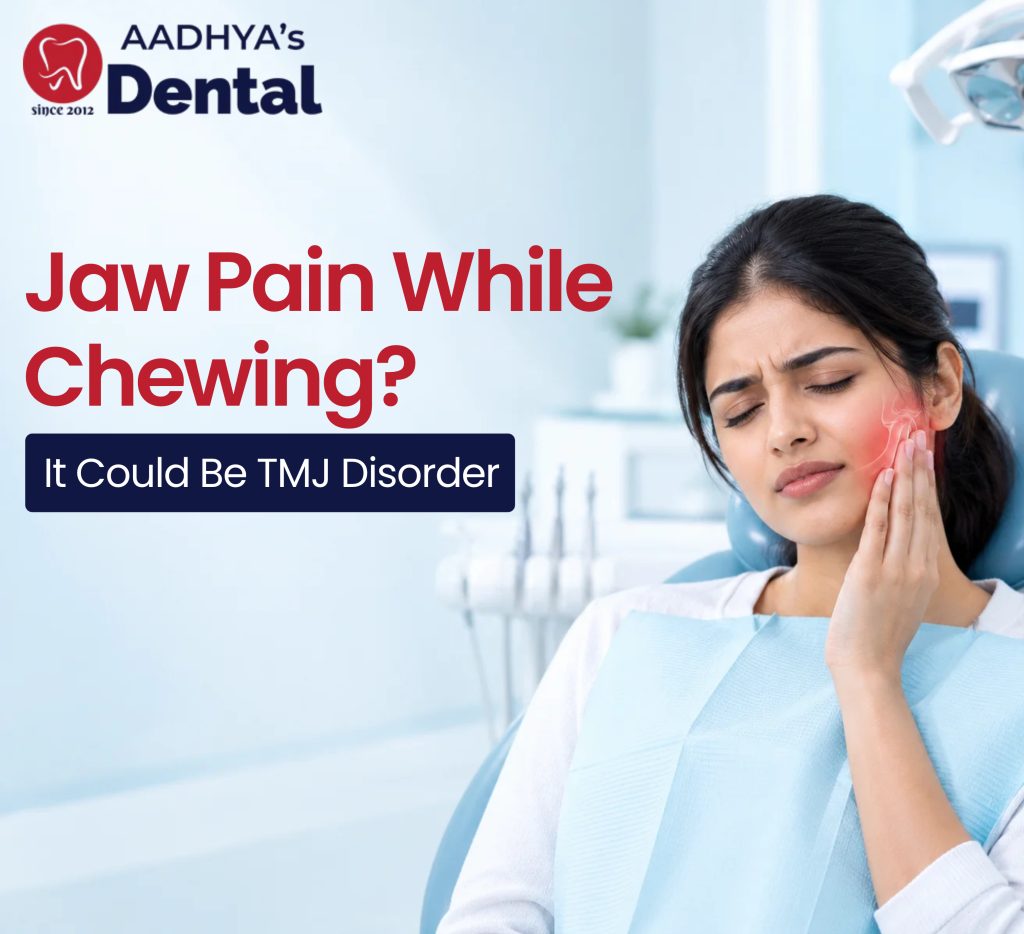
Does your jaw hurt when you chew? Do you notice clicking or popping near your ear, stiffness when opening your mouth, or discomfort while eating hard or chewy foods?
Jaw pain while chewing should not always be dismissed as ordinary dental pain. It can sometimes be related to temporomandibular disorders (TMD), which involve the jaw joints and the muscles responsible for jaw movement.
At Aadhya’s Dental, Nallagandla, TMJ-related symptoms are assessed carefully to understand the possible cause before deciding on treatment.
Dr Mrudula focuses on gentle, patient-centred care, careful listening, counselling and conservative management. An important part of her approach is identifying stress, teeth clenching and other habits that may be putting additional strain on the jaw. When appropriate, she may also recommend low-level laser therapy (LLLT) as part of conservative care.
For patients with complex TMJ conditions that may require surgical treatment, Dr. Krishna Kishore, Oral & Maxillofacial Surgeon, provides specialist evaluation and surgical management when indicated.
Also Read : https://aadhyasdental.com/meet-dr-krishna-kishore-oral-maxillofacial-surgeon-at-aadhyas-dental-nallagandla/
Why Does My Jaw Hurt While Chewing?
Every time you chew, your jaw joints and chewing muscles work together.
If these structures become overloaded, irritated or tense, you may experience pain while eating or opening your mouth.
Possible contributing factors include:
- Teeth clenching or grinding
- Stress and muscle tension
- Excessive chewing or frequent gum chewing
- Previous jaw or facial trauma
- Joint inflammation
- Arthritis
- Problems involving the structures inside the joint
- Certain muscle or jaw-related conditions
In some patients, several factors may contribute to the symptoms.
That is why a proper TMJ evaluation in Nallagandla is important rather than assuming that every case of jaw pain has the same cause.
Can Stress Really Cause Jaw Pain?
Stress can play an important role in jaw discomfort.
When people are stressed, concentrating or anxious, they may unconsciously tighten their jaw or clench their teeth. Some people also grind their teeth during sleep.
Over time, repeated clenching can place excessive workload on the chewing muscles and jaw joints.
You may notice:
- Jaw pain while eating
- Morning jaw stiffnessa Q`1
- Facial muscle tenderness
- Headaches around the temples
- Jaw fatigue
- Tooth sensitivity
- Increased clicking or discomfort
- Difficulty relaxing the jaw
The patient may not even realise that stress-related clenching is happening.
Dr Mrudula’s Counselling Approach to TMJ Care
At Aadhya’s Dental, Dr Mrudula takes time to listen to the patient’s symptoms and understand their daily habits and stress-related factors.
Instead of concentrating only on the painful joint, she may counsel patients about habits that could be contributing to their jaw discomfort.
For example, patients may be encouraged to become aware of:
“Are my teeth touching when I am not eating?”
They may also be advised to notice whether they:
- Clench while working at a computer
- Tighten their jaw while driving
- Clench when concentrating
- Grind their teeth at night
- Chew gum excessively
- Bite their nails or other objects
- Tighten their jaw during stressful situations
Also Read : https://aadhyasdental.com/meet-dr-g-mrudula-periodontist-oral-implantologist-at-aadhyas-dental/
Changing the Stress Factor Matters
If stress is contributing to jaw clenching, simply treating the pain may not address the underlying habit.
Dr Mrudula’s counselling therefore focuses on helping patients recognise and modify stress-related jaw habits wherever these are relevant.
This may include jaw relaxation awareness, reducing unnecessary clenching, modifying chewing habits and addressing behaviours that repeatedly strain the jaw.
The goal is to help patients become more aware of what may be triggering or aggravating their symptoms.
Low-Level Laser Therapy for TMJ Pain
For selected patients, low-level laser therapy (LLLT) may be incorporated into conservative TMJ care.
LLLT, also called photobiomodulation, uses low-intensity light and may be used to help manage pain and muscle- or tissue-related discomfort in appropriate cases.
At Aadhya’s Dental, Dr Mrudula may recommend low-level laser therapy for suitable TMJ-related symptoms after assessing the patient’s condition.
It is important to understand that laser therapy is not appropriate for every type of TMD. A patient with primarily muscle-related discomfort may require a different approach from someone with a significant structural problem within the jaw joint.
The treatment should therefore be selected according to the individual’s diagnosis.
What Does Conservative TMJ Treatment Involve?
Not every patient with jaw pain needs an invasive procedure.
Depending on the underlying cause, conservative treatment may include:
- Stress and habit counselling
- Jaw relaxation techniques
- Dietary modifications
- Avoiding excessive chewing
- Managing clenching and grinding
- Jaw exercises or physiotherapy guidance when appropriate
- Medication when clinically indicated
- Night guards or occlusal appliances for selected patients
- Low-level laser therapy where appropriate
The aim is to reduce unnecessary strain and address contributing factors while monitoring the patient’s response.
Signs That Your Jaw Pain Needs Attention
Jaw pain while chewing deserves an evaluation when it is persistent, worsening or affecting normal activities.
Look out for:
Pain While Eating
If chewing regularly causes jaw pain, especially with harder foods, an evaluation can help determine the cause.
Jaw Clicking With Pain
A clicking sound alone does not necessarily indicate a serious problem. Clicking accompanied by pain or restricted movement is more concerning.
Difficulty Opening Your Mouth
If you cannot open your mouth as comfortably or as widely as before, professional assessment is advisable.
Jaw Locking
Repeatedly feeling that your jaw is stuck open or closed should not be ignored.
Facial or Temple Pain
Jaw muscle tension may sometimes be associated with facial discomfort or headaches.
Symptoms After Trauma
Jaw pain following an accident, blow to the face, or other injury requires appropriate evaluation.
When Is TMJ Surgery Considered?
Surgery is not automatically required for TMJ pain.
Many patients can initially be managed with conservative approaches. However, some complex conditions may require specialist evaluation.
This is where Dr Krishna Kishore, Oral & Maxillofacial Surgeon at Aadhya’s Dental, plays an important role.
He evaluates complex jaw and TMJ conditions where there may be a structural problem or a potential need for surgical treatment.
Surgical evaluation may be appropriate in selected patients with:
- Severe or persistent TMJ symptoms
- Significant limitation of jaw movement
- Recurrent jaw locking
- Structural joint abnormalities
- Significant jaw trauma
- Persistent symptoms despite appropriate conservative management
- Conditions where surgical intervention may be indicated
The purpose of specialist evaluation is to determine whether surgery is actually necessary, not to assume that every patient with TMJ pain needs an operation.
Dr Mrudula and Dr. Krishna Kishore: A Comprehensive TMJ Approach
At Aadhya’s Dental, the approach can be tailored according to the nature and complexity of the patient’s condition.
Dr Mrudula — Gentle and Conservative TMJ Care
Dr Mrudula’s approach emphasises:
- Gentle patient care
- Listening carefully to the patient’s concerns
- Patient counselling
- Identifying stress-related clenching
- Helping patients modify contributing habits
- Conservative treatment
- Jaw relaxation and lifestyle guidance
- Low-level laser therapy when clinically appropriate
Her focus is on understanding the patient as a whole and addressing factors that may be contributing to jaw discomfort.
Dr Krishna Kishore — Oral & Maxillofacial Surgical Evaluation
Dr Krishna Kishore, Oral & Maxillofacial Surgeon, focuses on complex TMJ and jaw-related conditions that may require specialist or surgical evaluation.
This includes assessing structural problems, significant jaw dysfunction and selected cases where surgical treatment may be appropriate.
Having access to both conservative and surgical expertise helps ensure that treatment is based on the actual cause and complexity of the patient’s TMJ problem.
Can TMJ Pain Be Treated Without Surgery?
In many cases, conservative management may be appropriate.
Addressing stress-related clenching, modifying jaw habits, reducing excessive chewing and using suitable therapies can help selected patients.
However, persistent symptoms should not simply be ignored. The appropriate treatment depends on the underlying diagnosis.
TMJ Treatment in Nallagandla
If you are searching for TMJ treatment in Nallagandla, jaw pain treatment near Nallagandla, TMJ dentist near Tellapur, or TMD treatment near Gachibowli, Aadhya’s Dental provides evaluation and personalised treatment planning.
The clinic is convenient for patients from:
- Nallagandla
- Tellapur
- Lingampally
- Gopanpally
- Gachibowli
- BHEL
- Miyapur
- Kondapur
- Financial District
- Vattinagulapally
- Nearby areas of Hyderabad
Whether your jaw pain appears to be associated with stress and clenching or requires more detailed joint evaluation, getting the cause assessed is the first step.
Frequently Asked Questions About Jaw Pain and TMJ
Why does my jaw hurt when I chew?
Jaw pain while chewing can be associated with clenching, grinding, muscle tension, joint problems, inflammation, trauma or other dental and jaw-related conditions.
Can stress make TMJ pain worse?
Yes. Stress may contribute to clenching and muscle tension, which can aggravate jaw discomfort in some patients. Addressing these habits can therefore be an important part of conservative care.
How does Dr Mrudula help patients with stress-related TMJ pain?
Dr Mrudula listens carefully to the patient’s concerns and counsels them about recognising stress-related clenching and other habits that may be putting unnecessary strain on the jaw.
What is low-level laser therapy for TMJ?
Low-level laser therapy, or photobiomodulation, uses low-intensity light and may be used in selected cases to help manage pain and muscle or tissue-related discomfort.
Does everyone with TMJ pain need laser treatment?
No. LLLT is not appropriate for every patient. Its use depends on the symptoms, diagnosis and clinical assessment.
Does TMJ always require surgery?
No. Many cases can initially be managed conservatively. Complex conditions may require evaluation by an oral and maxillofacial surgeon.
When should I see Dr Krishna Kishore for TMJ?
Patients with severe or persistent symptoms, recurrent locking, significant restriction of movement, structural joint concerns or symptoms following significant trauma may benefit from specialist evaluation by an Oral & Maxillofacial Surgeon.
Is jaw clicking always a problem?
Not necessarily. Clicking without pain or functional difficulty can occur in otherwise healthy individuals. However, clicking accompanied by pain, locking or restricted movement should be assessed.
Book Your TMJ Consultation at Aadhya’s Dental
Don’t let jaw pain while chewing become a daily problem.
If you are experiencing jaw pain, TMJ discomfort, clicking with pain, jaw stiffness, difficulty opening your mouth or recurrent jaw locking, schedule a consultation at Aadhya’s Dental, Nallagandla.
Dr Mrudula can evaluate your symptoms and provide gentle, patient-centred care, including counselling for stress-related jaw clenching, conservative treatment and low-level laser therapy when appropriate.
If your condition appears complex or may require surgical treatment, Dr Krishna Kishore, Oral & Maxillofacial Surgeon, can provide specialist TMJ evaluation and surgical management when indicated.
📅 Book Your Appointment Today
Call Aadhya’s Dental, Nallagandla, to schedule your TMJ consultation.
Early evaluation can help you understand the cause of your jaw pain and choose the right treatment approach.
Aadhya’s Dental, Nallagandla — Gentle care for TMJ concerns, personalised counselling and specialist surgical evaluation when needed.