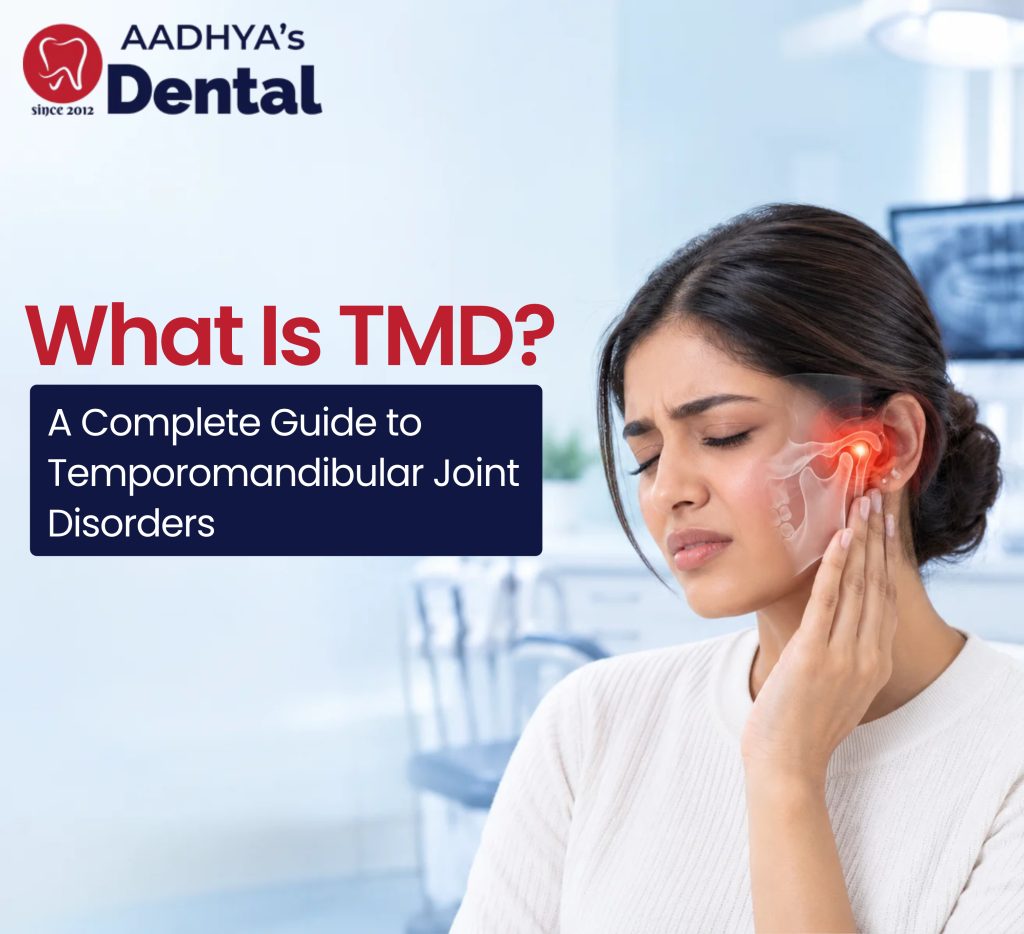
Jaw pain, clicking sounds while opening the mouth, difficulty chewing, headaches or a feeling that your jaw is getting “stuck” can sometimes be related to the temporomandibular joint (TMJ).
The group of conditions that affect the jaw joint, the surrounding muscles and the structures involved in jaw movement is commonly referred to as temporomandibular disorders (TMD).
TMD can range from mild, temporary discomfort to more complex problems that affect eating, speaking, sleep and everyday activities. Because jaw pain can have several possible causes, a proper clinical assessment is important before deciding on treatment.
At Aadhya’s Dental, Nallagandla, TMJ and TMD concerns are evaluated with an emphasis on understanding the patient’s symptoms, identifying possible contributing factors and choosing treatment according to the severity and nature of the condition.
Dr Mrudula focuses on a gentle, patient-centred approach, with careful listening, counselling and conservative treatment wherever appropriate. When laser-based treatment has a role in managing suitable dental or soft-tissue-related conditions, it may also be considered as part of the overall treatment approach.
For patients with complex TMJ conditions or cases that may require surgical evaluation, Dr Krishna Kishore, Oral & Maxillofacial Surgeon, can provide specialist assessment and determine whether a surgical approach is indicated.
Also Read : https://aadhyasdental.com/tmj-specialist-near-tellapur-dr-krishna-kishore-at-aadhyas-dental-nallagandla/
What Is TMD?
Temporomandibular disorders (TMD) are conditions affecting the temporomandibular joints, the jaw muscles and related structures.
You have two TMJs—one on each side of your face, just in front of your ears. These joints allow your lower jaw to move when you:
- Open and close your mouth
- Chew food
- Speak
- Yawn
- Swallow
Because the TMJ is involved in so many everyday movements, problems affecting this area can become noticeable very quickly.
TMD is not one single disease. It is a broad term used for different disorders that can affect the jaw joint and associated muscles.
What Are the Symptoms of TMD?
TMD symptoms can vary significantly from person to person.
Common symptoms include:
1. Jaw Pain
You may experience pain around the jaw joint or in the muscles used for chewing.
The discomfort may become more noticeable while eating, chewing gum, yawning or opening the mouth widely.
2. Clicking or Popping Sounds
A clicking, popping or grinding sound from the jaw joint is relatively common.
A sound by itself does not necessarily mean that you have TMD. However, if clicking is accompanied by pain, restricted jaw movement or locking, it deserves professional evaluation.
3. Difficulty Opening the Mouth
Some people notice that their mouth does not open as widely as it used to.
You may feel stiffness or discomfort when trying to open your mouth fully.
4. Jaw Locking
The jaw may occasionally feel as though it is stuck open or closed.
Repeated locking should not be ignored because it can be associated with certain internal joint problems.
5. Headaches
Some TMD conditions can be associated with pain around the temples or forehead.
However, headaches can have many causes, so they should not automatically be attributed to the TMJ.
6. Ear-Area Discomfort
Because the TMJ is located close to the ear, some people with TMD report discomfort around the ear area.
This does not necessarily mean that the ear itself is the source of the problem.
7. Pain While Chewing
Chewing may become uncomfortable, particularly with harder or chewy foods.
Some people gradually start avoiding certain foods because of jaw discomfort.
What Causes TMD?
There is usually not one single cause.
Possible contributing factors include:
- Jaw joint injury or trauma
- Problems involving the jaw joint structures
- Excessive clenching or grinding
- Stress-related muscle tension
- Certain bite-related factors
- Muscle inflammation or tenderness
- Arthritis affecting the jaw joint
- Disc displacement within the joint
- Repetitive overuse of the jaw
- Previous facial or jaw injuries
In many patients, several factors may contribute at the same time.
This is why a personalised TMD evaluation is more useful than assuming that every patient needs the same treatment.
Is Jaw Clicking Always TMD?
Not necessarily.
A person may have a clicking jaw without pain, restricted movement or other symptoms.
However, if clicking is accompanied by:
- Pain
- Jaw locking
- Difficulty opening the mouth
- Difficulty chewing
- Swelling
- Progressive changes in jaw movement
Then a dental evaluation is advisable.
The important question is not simply “Does my jaw click?” but rather “Are there other symptoms or functional changes associated with the clicking?”
How Is TMD Diagnosed?
There is no single test that diagnoses every type of TMD.
A dentist or oral and maxillofacial specialist may evaluate:
- Your symptoms and their duration
- Jaw movement
- Areas of tenderness
- Muscle tenderness
- Joint sounds
- Jaw opening
- History of trauma
- Clenching or grinding habits
- Changes in bite or jaw function
Depending on the clinical findings, imaging may sometimes be recommended.
The objective is to determine whether the symptoms are likely related to the jaw joint, the chewing muscles, another dental problem or another condition altogether.
Dr Mrudula’s Approach to TMD Care
TMD treatment does not always begin with an invasive procedure.
At Aadhya’s Dental, Dr Mrudula’s approach emphasises gentle care, patience, careful listening and counselling.
Understanding the patient’s daily habits, symptoms and concerns is an important part of the consultation.
Where appropriate, treatment may initially focus on conservative measures rather than immediately considering invasive intervention.
Depending on the diagnosis, conservative management may involve:
- Jaw rest
- Dietary modifications
- Avoiding excessive chewing
- Managing clenching habits
- Warm or cold applications when appropriate
- Jaw exercises or physiotherapy guidance when indicated
- Stress and habit counselling
- Occlusal appliances/night guards in selected cases
- Medication when clinically appropriate
The treatment plan should be based on the individual patient’s condition rather than applying the same treatment to everyone.
What Is Conservative Treatment for TMD?
Conservative treatment means beginning with approaches that aim to manage symptoms and improve jaw function without unnecessarily moving to invasive procedures.
For selected patients, this may be an appropriate first step.
Conservative TMD care can include lifestyle and habit modifications, dietary changes, exercises, counselling and other non-surgical approaches.
For many patients, reassurance and understanding their jaw habits can also be an important part of management.
Not every clicking jaw requires surgery, and not every case of jaw pain requires an aggressive intervention.
Can Laser Treatment Help TMD?
Laser-based treatment may have a role in selected situations, depending on the cause of the patient’s symptoms and the clinical assessment.
At Aadhya’s Dental, Dr Mrudula’s interest in laser-based dental treatment can be incorporated into the treatment plan when laser therapy is clinically appropriate.
However, laser treatment is not a universal treatment for every type of TMD.
The underlying cause of the symptoms must first be evaluated. A joint problem, muscle-related problem and dental problem may require completely different approaches.
When Should You See an Oral & Maxillofacial Surgeon?
Most patients with jaw discomfort do not automatically need surgery.
However, some TMJ conditions can be more complex and may require specialist evaluation.
Dr. Krishna Kishore, Oral & Maxillofacial Surgeon at Aadhya’s Dental, is positioned for the evaluation of complex TMJ and jaw-related conditions, particularly when there are concerns that may require surgical assessment.
Specialist evaluation may be considered when there is:
- Persistent or severe jaw pain
- Repeated jaw locking
- Significant restriction in mouth opening
- Suspected structural joint problems
- Significant jaw trauma
- Progressive deterioration of jaw function
- Symptoms that do not improve with appropriate conservative management
- A condition where surgical treatment may need to be considered
The purpose of specialist evaluation is not to assume that surgery is necessary, but to determine what treatment is actually appropriate for the individual patient.
Dr Mrudula and Dr Krishna Kishore: A Comprehensive Approach to TMJ Care
One of the advantages of having different areas of expertise available within the same dental setting is that patients can be evaluated according to the complexity of their condition.
Dr. Mrudula focuses on:
- Gentle and patient-centred care
- Listening carefully to symptoms
- Patient counselling
- Conservative TMD management
- Habit and lifestyle guidance
- Non-invasive approaches where appropriate
- Laser-based treatment where clinically indicated
Dr Krishna Kishore, Oral & Maxillofacial Surgeon, focuses on:
- Complex TMJ conditions
- Jaw-related structural problems
- Maxillofacial evaluation
- Cases requiring specialist surgical assessment
This allows the treatment approach to be tailored to the patient’s actual needs rather than assuming that every TMJ problem requires the same solution.
Can Stress Make TMD Symptoms Worse?
Stress does not necessarily mean that stress is the original cause of TMD.
However, stress may be associated with habits such as jaw clenching or teeth grinding, which can place additional strain on the chewing muscles and jaw joints.
This is one reason why counselling and identifying habits can be useful components of TMD management.
Dr Mrudula’s patient-centred approach includes taking time to understand these factors rather than looking only at the jaw joint itself.
TMD and Teeth Grinding
Teeth grinding and jaw clenching can increase the workload on the muscles and joints involved in chewing.
Some patients may clench their teeth during the day without realising it. Others may grind their teeth while sleeping.
If you regularly wake up with:
- Jaw stiffness
- Facial muscle soreness
- Headaches
- Tooth sensitivity
- Worn or damaged teeth
It may be worth discussing these symptoms with a dentist.
Does TMD Always Need Treatment?
Not necessarily.
Some mild jaw symptoms may be temporary and may not require extensive treatment.
However, persistent pain, locking, restricted jaw movement or worsening symptoms should be assessed.
The appropriate approach depends on:
- The cause
- Severity
- Duration
- Impact on daily activities
- Joint and muscle findings
- Response to initial treatment
A professional evaluation helps determine whether observation, conservative treatment or specialist assessment is appropriate.
TMD Treatment Near Nallagandla
Patients searching for TMD treatment near Nallagandla, TMJ pain treatment in Nallagandla, or a TMJ specialist near Tellapur and Gachibowli can consult Aadhya’s Dental for evaluation.
The clinic is conveniently located for patients from nearby areas including:
- Nallagandla
- Tellapur
- Lingampally
- Gopanpally
- Gachibowli
- BHEL
- Miyapur
- Kondapur
- Financial District
- Vattinagulapally
- Narsingi and surrounding areas
If you have persistent jaw pain or difficulty opening your mouth, it is better to have the problem assessed rather than repeatedly ignoring the symptoms.
Frequently Asked Questions About TMD
Is TMD the same as TMJ?
No. TMJ refers to the temporomandibular joint itself. TMD refers to disorders affecting the TMJ, jaw muscles or related structures.
Is jaw clicking dangerous?
Not necessarily. Clicking without pain or functional problems may not require treatment. However, clicking associated with pain, locking or restricted movement should be evaluated.
Can TMD go away on its own?
Some symptoms can improve over time, particularly when contributing habits are addressed. Persistent or worsening symptoms should be evaluated by a dental professional.
Does TMD require surgery?
No. Many TMD cases are managed conservatively. Surgery is generally considered only for selected complex conditions after appropriate evaluation.
Can a dentist treat TMD?
Yes. A dentist can assess many TMD symptoms and determine whether conservative management is appropriate or whether referral for specialist evaluation is needed.
When should I see an oral and maxillofacial surgeon for TMJ problems?
Persistent severe symptoms, significant restriction in jaw movement, recurrent locking, structural joint problems, trauma or cases that may require surgical evaluation can warrant assessment by an oral and maxillofacial surgeon such as Dr Krishna Kishore.
Does laser treatment work for every TMD patient?
No. Laser treatment is not appropriate for every type of TMD. Its use depends on the diagnosis and clinical suitability.
Can stress cause jaw pain?
Stress can contribute to clenching, grinding and muscle tension, which may aggravate jaw discomfort in some people. A proper evaluation is needed to identify the actual contributing factors.
Final Thoughts
TMD is not a single condition, and there is no one-size-fits-all treatment.
Jaw clicking, facial pain, headaches, difficulty chewing and restricted mouth opening can have different causes. A careful evaluation is therefore the first step toward choosing the right treatment.
At Aadhya’s Dental, Nallagandla, Dr Mrudula emphasises gentle care, patience, listening, counselling and conservative treatment wherever appropriate, with laser-based approaches considered when clinically suitable.
For patients with more complicated jaw or TMJ conditions, Dr Krishna Kishore, Oral & Maxillofacial Surgeon, provides specialist evaluation of complex cases and surgical considerations when required.
If you are experiencing persistent TMJ pain, jaw clicking with pain, jaw locking, difficulty opening your mouth or other symptoms of TMD, getting an appropriate assessment can help you understand the cause and avoid unnecessary treatment.
Aadhya’s Dental, Nallagandla — patient-focused evaluation and personalised care for TMJ and TMD concerns.call :+91-7396235802