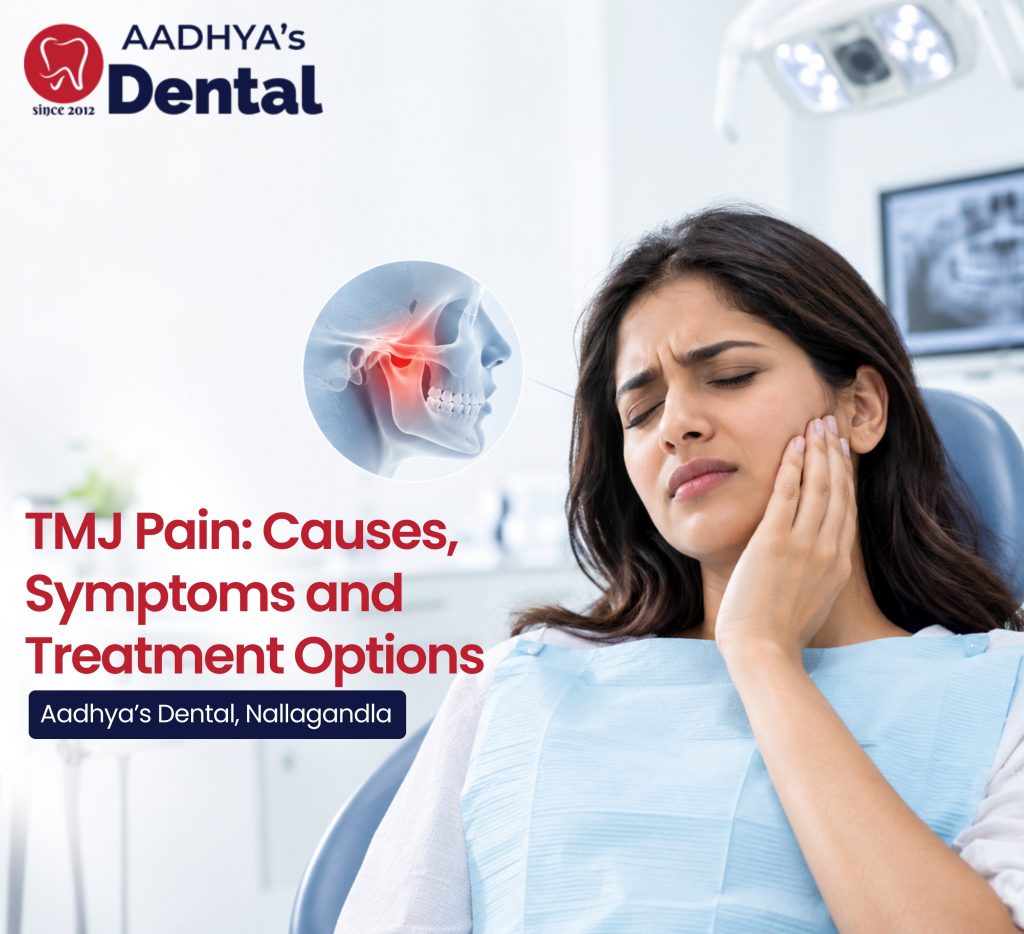
Jaw pain, clicking sounds while opening the mouth, difficulty chewing, headaches, or even pain around the ear may sometimes be related to the temporomandibular joint (TMJ). Because TMJ disorders can have several different causes, identifying the underlying problem is often more important than simply treating the pain.
At Aadhya’s Dental, Nallagandla, TMJ-related concerns are evaluated with a patient-centred approach. Dr Mrudula focuses on gentle care, careful listening, counselling and conservative treatment whenever appropriate, while Dr Krishna Kishore, Oral & Maxillofacial Surgeon, provides evaluation for complex TMJ conditions and cases that may require surgical consideration.
Whether you are looking for TMJ pain treatment in Nallagandla, a TMJ specialist near Tellapur, or evaluation for persistent jaw pain around Gachibowli, Lingampally, Gopanpally or the Financial District, an early assessment can help determine the right treatment pathway.
For further information about how to prepare for your first visit to a dental clinic Also Read : https://aadhyasdental.com/how-to-prepare-for-your-first-visit-to-a-dental-clinic/
What Is the TMJ?
The temporomandibular joint connects your lower jawbone to your skull. You have one joint on each side of your face, located just in front of your ears.
These joints allow you to:
- Open and close your mouth
- Chew food
- Speak
- Yawn
- Move your jaw from side to side
Because the TMJ works repeatedly throughout the day, problems involving the joint, surrounding muscles, ligaments or bite can result in temporomandibular disorders (TMD).
Importantly, not every jaw click means that there is a serious TMJ disorder. A proper clinical assessment is useful when symptoms are persistent, painful or affecting daily activities.
What Does TMJ Pain Feel Like?
TMJ problems can produce different symptoms from person to person.
Common symptoms include:
- Pain near the jaw joint
- Jaw muscle tenderness
- Pain while chewing
- Clicking or popping sounds
- Difficulty opening the mouth fully
- Jaw stiffness
- A feeling that the jaw is getting stuck
- Headaches associated with jaw-muscle tension
- Pain around the ear without an obvious ear problem
- Facial discomfort
- Pain while yawning
- Changes in the way the teeth come together
Some people notice symptoms mainly in the morning, particularly if they clench or grind their teeth during sleep.
Others may develop jaw discomfort during periods of stress, prolonged chewing or after an injury.
Also Read : https://aadhyasdental.com/tmj-specialist-near-tellapur-dr-krishna-kishore-at-aadhyas-dental-nallagandla/
What Causes TMJ Pain?
TMJ pain does not always have one single cause. Several factors may contribute.
1. Teeth Clenching and Grinding
Bruxism, or repeated clenching and grinding of the teeth, can overload the jaw muscles and TMJ.
Some people are unaware that they clench their teeth, particularly while sleeping or concentrating.
2. Stress and Muscle Tension
Stress can influence jaw-clenching habits and muscle tension. This is why counselling and awareness of jaw habits can be an important part of conservative TMJ care.
Learning to recognise when you are unnecessarily tightening your jaw can sometimes make a meaningful difference.
3. Jaw Joint Problems
The disc within the TMJ can sometimes move out of its normal position, or the joint can develop inflammatory or degenerative changes.
These conditions may produce clicking, locking, pain or restricted jaw movement.
4. Trauma or Injury
A blow to the jaw, facial injury or accident can affect the TMJ and surrounding structures.
Patients with a history of significant facial trauma may require more detailed assessment.
5. Arthritis and Degenerative Changes
Different forms of arthritis can affect the temporomandibular joint and may result in pain, stiffness or changes in jaw movement.
6. Excessive Jaw Strain
Repeated chewing of very hard or chewy foods, prolonged gum chewing or excessive mouth opening may aggravate an already sensitive jaw joint.
Is Every Jaw Click a TMJ Disorder?
Not necessarily.
A clicking or popping sound can occur in people who have no pain or functional limitation. However, if clicking is accompanied by pain, locking, difficulty opening the mouth or progressive changes in jaw movement, it deserves professional evaluation.
The goal is not simply to make every joint silent. The goal is to understand whether the joint is healthy and functioning comfortably.
When Should You See a Dentist for TMJ Pain?
Consider getting your jaw evaluated if you have:
- Persistent jaw pain
- Pain while chewing
- Recurrent headaches associated with jaw discomfort
- Difficulty opening or closing your mouth
- Jaw locking
- Significant clicking associated with pain
- Facial pain that keeps returning
- Pain following an injury
- Increasing difficulty eating
- Symptoms that are interfering with sleep or daily activities
Early assessment may help prevent unnecessary progression of a problem and can also help rule out other causes of facial or jaw pain.
How Is TMJ Pain Diagnosed?
TMJ diagnosis generally begins with a detailed history and clinical examination.
At Aadhya’s Dental, the evaluation may include discussion about:
- Where the pain occurs
- How long the symptoms have been present
- Whether the pain is related to chewing
- Jaw clicking or locking
- Clenching and grinding habits
- Stress-related jaw tension
- Previous trauma
- Changes in the bite
- Range of jaw movement
- Tenderness of the jaw muscles and joint
Depending on the findings, imaging may be recommended when clinically appropriate.
The important point is that TMJ treatment should be based on the cause and severity of the problem rather than a one-treatment-fits-all approach.
Also Read : https://aadhyasdental.com/can-a-dentist-treat-my-jaw-pain/
TMJ Treatment Options
Treatment depends on the specific diagnosis.
Many patients can initially be managed with conservative approaches rather than invasive procedures.
1. Conservative TMJ Care
For appropriate patients, treatment may involve:
- Resting the jaw
- Avoiding excessive chewing
- Temporarily choosing softer foods
- Avoiding very wide mouth opening
- Awareness of daytime clenching
- Jaw relaxation techniques
- Stress-management and counselling
- Appropriate exercises or physiotherapy recommendations
- Medication when clinically indicated
Dr Mrudula at Aadhya’s Dental, Nallagandla, places particular emphasis on listening carefully to the patient’s symptoms and explaining the condition clearly before deciding on treatment.
Her approach focuses on gentle, patient-centred and conservative TMJ care whenever appropriate.
2. Counselling and Jaw-Habit Modification
TMJ pain is sometimes closely connected with unconscious jaw habits.
Patients may clench their teeth while:
- Working at a computer
- Driving
- Studying
- Exercising
- Concentrating
- Feeling stressed
Simply becoming aware of these habits can be an important first step.
Dr Mrudula takes time to explain these factors and counsel patients about practical ways to reduce unnecessary jaw tension.
3. Night Guards in Selected Patients
For patients with significant clenching or grinding, an appropriately designed occlusal appliance may sometimes be recommended.
However, a night guard is not automatically required for every person with TMJ pain. Its suitability depends on the individual’s diagnosis and clinical findings.
For further information about bite guards, night guards , also read : https://aadhyasdental.com/bite-guards-night-guards/
4. Laser-Based Treatment Where Appropriate
Laser technology may have a role in selected dental and soft-tissue treatment situations, depending on the diagnosis.
At Aadhya’s Dental, Dr Mrudula may consider laser-based treatment where clinically appropriate, rather than presenting laser treatment as a universal solution for every TMJ problem.
This distinction is important because TMJ disorders have different causes and may require completely different approaches.
5. Evaluation of Complex TMJ Conditions
Some TMJ problems are more complicated and may require specialist oral and maxillofacial evaluation.
This is where Dr Krishna Kishore, Oral & Maxillofacial Surgeon at Aadhya’s Dental, can be involved.
Complex cases may require assessment of:
- Significant jaw restriction
- Recurrent locking
- Structural joint problems
- Significant trauma-related TMJ problems
- Advanced joint pathology
- Conditions that do not respond adequately to conservative management
- Cases where surgical treatment may need to be considered
The purpose of surgical evaluation is not that every complex TMJ problem requires surgery. Rather, an Oral & Maxillofacial Surgeon can determine whether there is a structural or surgical component that needs further management.
Dr Mrudula’s Approach to TMJ Care
TMJ pain can be frustrating because patients may not always know what is causing it.
At Aadhya’s Dental, Dr Mrudula’s approach begins with listening.
She focuses on understanding:
- What the patient is experiencing
- When the pain occurs
- Whether stress or clenching may be contributing
- How the jaw functions during eating and speaking
- Whether symptoms are improving or worsening
Patients are also given time to understand their condition and treatment options.
This gentle, patient and counselling-oriented approach can be particularly valuable for people who are anxious about dental treatment or who have been experiencing unexplained facial or jaw discomfort.
Dr Krishna Kishore: Oral & Maxillofacial Evaluation for Complex TMJ Problems
For patients with complicated jaw-joint conditions, previous facial trauma or suspected structural problems, evaluation by an Oral & Maxillofacial Surgeon may be appropriate.
Dr Krishna Kishore at Aadhya’s Dental, Nallagandla, provides oral and maxillofacial surgical evaluation for complex conditions involving the jaw and facial structures.
His role is particularly relevant when a patient’s symptoms suggest that more than routine conservative dental care may be required.
The two approaches can therefore complement each other:
Dr Mrudula → gentle assessment, listening, counselling and conservative TMJ management
Dr Krishna Kishore → complex TMJ assessment and oral & maxillofacial surgical evaluation when indicated
TMJ Pain and Stress: Is There a Connection?
Stress does not mean that TMJ pain is “only psychological.”
However, stress can contribute to muscle tension and unconscious clenching, which may aggravate jaw symptoms in some people.
This is why a good TMJ assessment should consider both physical and behavioural factors.
Patients may benefit from understanding their jaw habits and learning how to consciously relax their jaw during the day.
TMJ Treatment Near Nallagandla, Tellapur and Gachibowli
If you are searching for TMJ pain treatment in Nallagandla, TMD treatment near Tellapur, or a dentist for jaw pain near Gachibowli, Aadhya’s Dental provides evaluation and treatment planning for patients from Nallagandla and surrounding areas.
Patients also visit from:
- Tellapur
- Gopanpally
- Lingampally
- BHEL
- Miyapur
- Kondapur
- Financial District
- Vattinagulapally
- Narsingi
- Hitech City and surrounding Hyderabad areas
For patients experiencing persistent jaw pain, clicking, locking or difficulty opening the mouth, getting the condition evaluated is often more useful than repeatedly treating the pain without identifying the underlying cause.
Frequently Asked Questions About TMJ Pain
1. Is TMJ pain serious?
TMJ pain is often manageable, particularly when the underlying cause is identified. However, persistent pain, locking, restricted jaw movement or symptoms following trauma should be professionally evaluated.
2. Can stress cause TMJ pain?
Stress can contribute to jaw clenching and muscle tension, which may aggravate TMJ symptoms. Counselling, awareness and conservative management may therefore be useful for some patients.
3. Does every TMJ problem require surgery?
No. Many TMJ conditions can initially be managed conservatively. Surgery is generally considered only when there is an appropriate clinical indication.
4. Can a dentist treat TMJ pain?
Yes, depending on the type and severity of the problem. A dentist can evaluate common TMJ-related symptoms and determine whether conservative management is appropriate or whether specialist referral is required.
5. When should I see an Oral & Maxillofacial Surgeon for TMJ?
An Oral & Maxillofacial Surgeon may be appropriate for complex TMJ conditions, significant trauma-related problems, severe restriction or locking, suspected structural joint abnormalities, or cases where surgical evaluation is being considered.
6. Is clicking in my jaw normal?
Jaw clicking without pain or functional problems can occur in some individuals. However, painful clicking, locking, restricted movement or worsening symptoms should be assessed.
7. Can laser treatment help TMJ pain?
Laser-based treatment may be considered in selected situations, depending on the diagnosis. It is not appropriate as a universal treatment for every TMJ disorder. A proper clinical evaluation should come first.
8. Can TMJ pain go away on its own?
Some mild symptoms may settle, but persistent or recurrent symptoms should not simply be ignored. If pain continues or jaw function is affected, professional evaluation is advisable.
9. Does a night guard cure TMJ?
A night guard may be helpful for selected patients, particularly when clenching or grinding is contributing to symptoms. It does not cure every type of TMJ disorder.
10. Where can I get TMJ pain evaluated in Nallagandla?
Aadhya’s Dental, Nallagandla, provides evaluation and treatment planning for TMJ and jaw-related complaints. Dr Mrudula focuses on gentle, patient-centred and conservative care where appropriate, while Dr Krishna Kishore provides oral and maxillofacial evaluation for complex cases.
Conclusion
TMJ pain can have many different causes, from clenching and muscle tension to joint-related problems, arthritis or previous trauma. Because of this, treatment should be individualised rather than based on a single treatment method.
At Aadhya’s Dental, Nallagandla, patients can receive a structured evaluation of their jaw symptoms.
Dr Mrudula emphasises gentle care, patience, careful listening, counselling and conservative treatment wherever appropriate, including consideration of laser-based treatment in suitable situations.
For more complex conditions, Dr Krishna Kishore, Oral & Maxillofacial Surgeon, provides specialist evaluation to determine whether the condition requires advanced investigation or surgical management.
If you have persistent TMJ pain, jaw clicking, jaw locking, difficulty opening your mouth or pain while chewing, getting the problem assessed can be the first step towards finding an appropriate treatment plan.
Get effective TMJ pain treatment at Aadhya’s Dental Clinic, Nallagandla. Call +91-73962 35802 to book your consultation today.