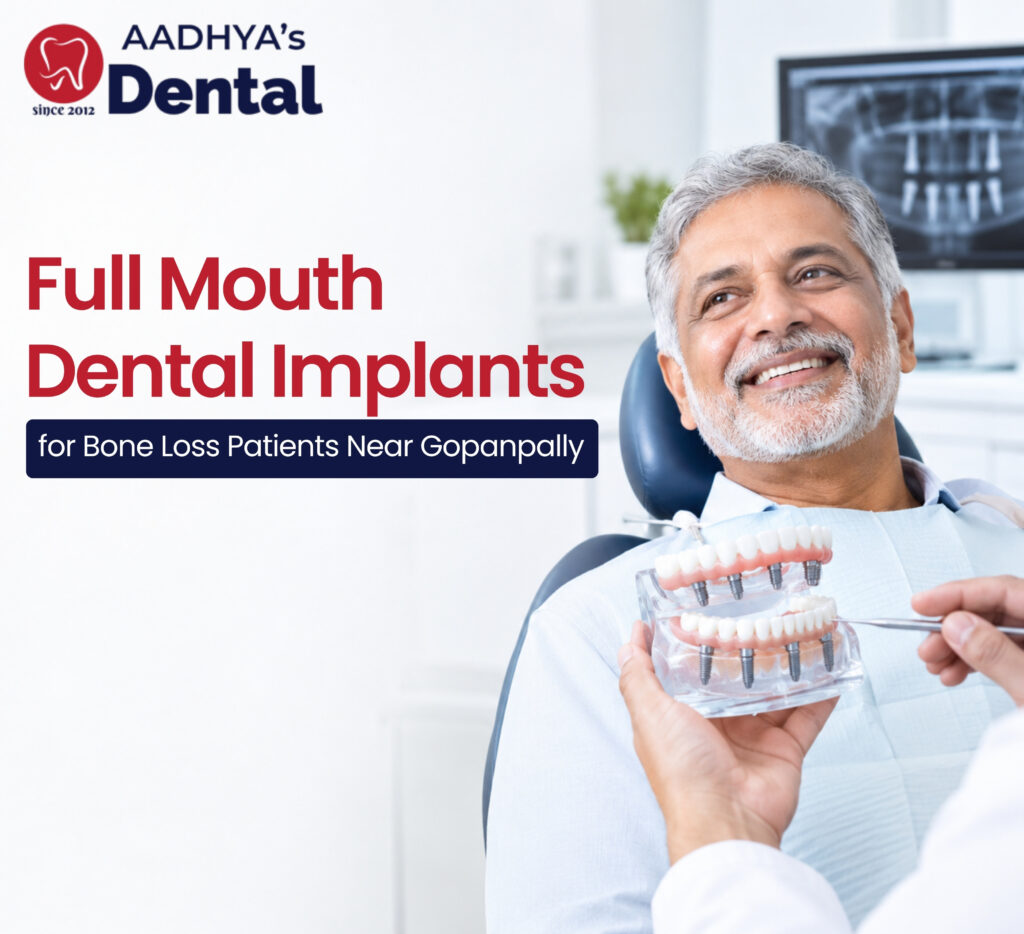
Patients who have lost teeth for many years may also have experienced jawbone loss, making conventional dental implant placement more challenging. However, depending on the amount and location of available bone, there may be several advanced implant treatment options that can be considered.
At Aadhya’s Dental, implant treatment is handled by Dr. Mrudula, Implantologist and MDS Periodontist, and Dr. Krishna Kishore, Implantologist and Oral & Maxillofacial Surgeon.
Dr. Mrudula has 14 years of clinical experience, while Dr. Krishna Kishore has 16 years of clinical experience, providing patients with access to experienced implant specialists for complex tooth replacement and full-mouth rehabilitation.
For further information about how to prepare for your first visit to a dental clinic Also Read : https://aadhyasdental.com/how-to-prepare-for-your-first-visit-to-a-dental-clinic/
What Are Full Mouth Dental Implants?
Full mouth dental implants are a treatment approach used to replace multiple missing teeth or an entire arch of teeth with implant-supported restorations.
Instead of replacing every missing tooth with an individual implant, carefully planned implant treatment may use a strategically positioned number of implants to support a fixed prosthesis, depending on the patient’s anatomy and treatment requirements.
For patients who have lost most or all of their teeth, implant-supported fixed teeth can provide an alternative to conventional removable dentures.
However, full mouth dental implants are not a single treatment plan that works identically for everyone.
The number and position of implants, type of restoration and need for additional procedures depend on factors such as:
- Available jawbone
- Bone density and quality
- Gum health
- Previous dental treatments
- Sinus anatomy in the upper jaw
- General oral health
- Existing medical conditions and medications
- Bite and jaw relationship
- Aesthetic and functional requirements
A detailed examination and appropriate imaging are therefore essential before treatment planning.
Can You Get Dental Implants If You Have Bone Loss?
This is one of the most common questions asked by patients with missing teeth.
Bone loss does not automatically mean that dental implants are impossible.
Dental implants require sufficient bone support for predictable placement and long-term stability. When bone has significantly reduced after tooth loss, the implantologist needs to determine whether enough suitable bone remains for conventional implant placement.
Depending on the situation, treatment may involve:
- Conventional dental implants
- Bone grafting
- Sinus augmentation
- Angled implant placement
- Implant-supported full-mouth rehabilitation
- Zygomatic implants in carefully selected cases
- Pterygoid implants in selected patients
- Other advanced implant techniques
The appropriate approach can only be determined after examining the patient’s individual anatomy.
Why Does Bone Loss Happen After Tooth Loss?
When a natural tooth is lost, the jawbone that previously supported that tooth no longer receives the same functional stimulation.
Over time, this can contribute to resorption of the jawbone.
Patients who have worn dentures for many years or have had missing teeth for a prolonged period may therefore have less bone available for conventional implant placement.
Bone loss can also be associated with:
- Advanced gum disease
- Long-standing missing teeth
- Traumatic tooth loss
- Infections
- Previous dental procedures
- Certain anatomical factors
This is why patients with long-standing tooth loss often require a more detailed implant assessment.
Full Mouth Implants for Patients With Severe Bone Loss
Patients with significant bone loss may require a different implant strategy from someone with adequate bone volume.
At Aadhya’s Dental, the treatment plan is based on the patient’s individual anatomy rather than assuming that one implant technique is suitable for everyone.
Depending on the case, an implantologist may consider conventional implants, grafting procedures or advanced implant techniques.
For selected patients with severe upper-jaw bone loss, zygomatic implants may sometimes be considered.
These implants use the stronger zygomatic bone of the cheek region for support rather than relying entirely on severely resorbed conventional jawbone.
Similarly, pterygoid implants may be considered in selected patients when the anatomy and treatment objectives make them appropriate.
These are advanced procedures and are not suitable for every patient.
Zygomatic Implants for Severe Upper Jaw Bone Loss
For patients with severe bone loss in the upper jaw, conventional implants may sometimes be difficult to place without extensive bone augmentation.
In carefully selected cases, zygomatic implants can provide an alternative approach.
Rather than being anchored primarily in the severely resorbed alveolar bone, zygomatic implants engage the zygomatic bone.
This can potentially help selected patients who have:
- Severe upper jaw bone loss
- Long-standing tooth loss
- Previous failed bone grafting
- Difficulty with conventional implant placement
- Severe jawbone resorption
However, zygomatic implant treatment is technically demanding and requires careful assessment and advanced surgical planning.
An experienced implantologist should determine whether it is appropriate for the individual patient.
Pterygoid Implants for Patients With Limited Upper Jaw Bone
Another advanced implant option that may be considered in selected patients is the pterygoid implant.
Pterygoid implants are positioned in the posterior region of the upper jaw and engage the pterygoid region for support.
They may be considered when conventional posterior maxillary implant placement is challenging because of reduced bone availability.
Like zygomatic implants, pterygoid implants are not appropriate for every patient.
The patient’s anatomy, bone condition, sinus relationship, bite and overall treatment plan must be evaluated before deciding whether this approach is suitable.
Meet the Implant Specialists at Aadhya’s Dental
Dr. Mrudula is an MDS Periodontist and Implantologist at Aadhya’s Dental, Nallagandla, with 14 years of clinical experience.
Her periodontal expertise is particularly valuable when implant patients also have gum disease, bone loss or compromised supporting tissues.
She focuses on:
- Dental implant treatment planning
- Implant-supported restorations
- Gum disease management before implants
- Periodontal health around implants
- Bone and gum evaluation
- Full-mouth dental rehabilitation
- Long-term implant maintenance
For patients with a history of severe gum disease, evaluating and controlling periodontal problems is an important part of implant planning.
Dr. Krishna Kishore – Oral & Maxillofacial Surgeon & Implantologist
Dr. Krishna Kishore is an Oral & Maxillofacial Surgeon and Implantologist with 16 years of clinical experience.
His surgical expertise is particularly relevant for patients requiring complex implant procedures and full-mouth rehabilitation.
His areas of implant and surgical expertise include:
- Full-mouth dental implants
- Immediate dental implants
- Same-day implant treatment in selected cases
- Zygomatic implants
- Pterygoid implants
- Complex tooth extractions
- Oral and maxillofacial surgery
- Full-mouth rehabilitation
- Management of complex jaw conditions
Having an Oral & Maxillofacial Surgeon and an MDS Periodontist/Implantologist available provides a multidisciplinary approach for patients whose implant cases involve both bone and gum-related concerns.
Why Gum Health Matters Before Dental Implants
Patients sometimes focus entirely on bone when considering implants.
But healthy gums and supporting tissues are also important for implant treatment.
Active periodontal disease can affect the tissues surrounding natural teeth and may also increase the risk of complications around implants.
For this reason, patients with:
- Bleeding gums
- Gum swelling
- Gum recession
- Severe tartar
- Periodontitis
- Loose teeth
- Previous gum disease
may need periodontal assessment and treatment before or alongside implant treatment.
This is where the expertise of Dr. Mrudula, MDS Periodontist and Implantologist, can be particularly valuable.
What Happens During a Full Mouth Implant Consultation?
A full-mouth implant treatment should begin with proper diagnosis rather than immediately deciding which implant technique to use.
At Aadhya’s Dental, the evaluation may include:
1. Clinical Examination
Your teeth, gums, jaw relationship and existing dental condition are evaluated.
2. Bone Assessment
The available bone is assessed to determine whether conventional implant placement is possible.
3. Dental Imaging
Appropriate imaging may be recommended to understand the three-dimensional anatomy and plan implant placement.
4. Gum Evaluation
The health of the gums and supporting tissues is assessed, particularly in patients with a history of periodontal disease.
5. Treatment Planning
Based on the findings, the implantologist discusses possible options.
Depending on the individual case, these may include conventional implants, grafting procedures, full-mouth implant rehabilitation or advanced options such as zygomatic or pterygoid implants.
6. Discussion of Restoration
The final teeth or prosthesis are an important part of implant treatment planning.
The goal is to consider both function and appearance, rather than focusing only on implant placement.
Is Bone Grafting Always Needed?
No.
Bone grafting is sometimes recommended when there is insufficient bone for conventional implant placement, but it is not automatically necessary for every patient with bone loss.
The decision depends on:
- Amount of remaining bone
- Bone width and height
- Implant location
- Desired implant position
- Quality of available bone
- Overall treatment plan
In selected cases, advanced implant techniques may be considered as alternatives to extensive grafting.
Your implantologist can explain which approach is appropriate after imaging and clinical evaluation.
Full Mouth Implants vs Dentures
Patients with complete tooth loss often compare dentures with implant-supported teeth.
Conventional Dentures
Dentures are removable prostheses that replace missing teeth and surrounding gum structures.
They can be a practical solution for many patients, but they may move during chewing or speaking, particularly when the jawbone has significantly resorbed.
Implant-Supported Teeth
Implant-supported restorations are anchored to dental implants placed in the jaw or, in selected cases, other supporting structures.
They can provide greater stability compared with conventional removable dentures.
However, implants involve surgery and require appropriate bone, healthy tissues and adequate maintenance.
The right option depends on your oral health, anatomy, expectations, budget and suitability for surgery.
Can Older Patients Get Full Mouth Dental Implants?
Age alone does not automatically rule out dental implant treatment.
Many older adults consider implants after losing teeth or becoming uncomfortable with removable dentures.
However, implant suitability depends on the individual’s:
- Oral health
- Bone condition
- Gum health
- Medical history
- Medications
- Healing capacity
- Ability to maintain oral hygiene
- Overall surgical suitability
A detailed evaluation is therefore more important than age alone.
Benefits of Full Mouth Dental Implants
For appropriately selected patients, implant-supported full-mouth rehabilitation may offer several potential benefits:
- Fixed replacement of missing teeth
- Improved chewing function
- Greater stability than conventional removable dentures
- Improved confidence while speaking and eating
- Restoration of dental function
- Support for a comprehensive full-mouth rehabilitation plan
The outcome varies from patient to patient, and realistic expectations are an important part of treatment planning.
How Long Do Dental Implants Last?
Dental implants are designed as long-term tooth replacement solutions, but their longevity depends on multiple factors.
These include:
- Oral hygiene
- Gum health
- Implant position
- Bone support
- Smoking or tobacco use
- Bite forces
- General health
- Regular professional maintenance
Even after receiving full-mouth dental implants, regular dental visits remain important.
Implants are not completely maintenance-free.
Full Mouth Dental Implants Near Gopanpally
If you live in or around Gopanpally, you may be searching for:
“full mouth dental implants near Gopanpally”
“dental implants near Gopanpally”
“implantologist near Gopanpally”
“full mouth implants near Gachibowli”
“dental implants near Financial District Hyderabad”
Aadhya’s Dental in Nallagandla is conveniently accessible to patients from Gopanpally and surrounding areas.
The clinic also serves patients from:
- Nallagandla
- Tellapur
- Gopanpally
- Gachibowli
- Financial District
- Nanakramguda
- Lingampally
- BHEL
- Serilingampally
- Kondapur
- Miyapur
- Vattinagulapally
- Osman Nagar
- Narsingi
- Tellapur Techno City
- HCU area
For patients from the Gopanpally–Nallagandla–Tellapur–Gachibowli corridor, Aadhya’s Dental provides access to experienced implant specialists without necessarily travelling to central Hyderabad for every stage of evaluation and treatment.
Why Choose Aadhya’s Dental for Full Mouth Dental Implants?
Two Experienced Implantologists
Aadhya’s Dental has Dr. Mrudula, MDS Periodontist & Implantologist, with 14 years of experience, and Dr. Krishna Kishore, Oral & Maxillofacial Surgeon & Implantologist, with 16 years of experience.
Periodontal and Surgical Expertise
Patients with severe bone loss may have complex gum and bone-related requirements. Having periodontal and maxillofacial surgical expertise can help with comprehensive treatment planning.
Advanced Implant Options
Depending on suitability, implant treatment may include conventional implants or advanced approaches such as zygomatic and pterygoid implants.
Individualised Treatment Planning
There is no single implant solution for every patient. Treatment is planned after evaluating the patient’s bone, gums, oral health and functional requirements.
Convenient Nallagandla Location
Aadhya’s Dental is located in Nallagandla, making it accessible for patients from Gopanpally, Tellapur, Gachibowli, Financial District and surrounding areas.
Frequently Asked Questions About Full Mouth Dental Implants and Bone Loss
1. Can I get full mouth dental implants if I have severe bone loss?
Possibly. Severe bone loss can make conventional implant placement more challenging, but selected patients may be candidates for bone grafting or advanced implant techniques. Your implantologist needs to assess your individual bone anatomy before recommending an option.
2. Are dental implants possible after wearing dentures for many years?
They may be possible. Long-term tooth loss and denture use can be associated with jawbone resorption, so an implant assessment is necessary to determine the available bone and suitable treatment options.
3. What if I don’t have enough bone for normal implants?
Depending on the location and severity of bone loss, options may include bone augmentation or advanced implant techniques. In selected upper-jaw cases, zygomatic or pterygoid implants may be considered.
4. What are zygomatic implants?
Zygomatic implants are specialised dental implants that use the zygomatic bone for support. They may be considered for selected patients with severe upper-jaw bone loss when conventional implant placement is difficult.
5. What are pterygoid implants?
Pterygoid implants are placed in the posterior upper-jaw region and engage the pterygoid area for support. They can be considered in selected cases where conventional posterior implant placement is challenging.
6. Are zygomatic implants suitable for everyone?
No. Zygomatic implants are advanced procedures and are appropriate only for selected patients after detailed clinical and radiographic evaluation.
7. Do I need bone grafting before full mouth implants?
Not necessarily. Some patients with bone loss may require grafting, while others may be suitable for alternative implant strategies. The decision depends on your individual anatomy and treatment plan.
8. Can gum disease patients get dental implants?
Patients with gum disease may still be candidates for implants, but active periodontal disease generally needs appropriate management. Gum health and implant health are closely related, making periodontal evaluation important.
9. Can loose teeth be replaced with full mouth dental implants?
If teeth have a poor prognosis because of advanced gum disease or other causes, extraction followed by implant-supported rehabilitation may sometimes be considered. The treatment plan depends on the condition of the remaining teeth and supporting bone.
10. Can senior citizens get full mouth dental implants?
Yes, many older adults may be candidates for implant treatment. Age alone is not the deciding factor. Overall health, oral condition, bone, gum health and surgical suitability must be evaluated.
11. How many implants are needed for a full mouth?
There is no fixed number that applies to every patient. The number and positioning of implants depend on the patient’s anatomy, bone availability, restoration design and treatment plan.
12. Are full mouth dental implants the same as All-on-4 or All-on-6?
All-on-4 and All-on-6 are specific approaches to supporting a full-arch restoration with a limited number of strategically placed implants. Whether such an approach is suitable depends on the patient’s bone anatomy and restorative requirements.
13. Who should I consult for complex dental implants?
For complex implant cases involving significant bone loss, gum disease or surgical challenges, evaluation by appropriately trained implant specialists is important. At Aadhya’s Dental, patients can consult Dr. Mrudula, MDS Periodontist & Implantologist, and Dr. Krishna Kishore, Oral & Maxillofacial Surgeon & Implantologist.
14. Where can I find full mouth dental implants near Gopanpally?
Aadhya’s Dental in Nallagandla provides implant consultation and full-mouth rehabilitation for patients from Gopanpally, Tellapur, Gachibowli, Financial District, Lingampally and surrounding areas.
Don’t Let Bone Loss Stop You From Exploring Your Options
If you have been told that you have insufficient bone for dental implants, don’t assume that you have no options.
Modern implant dentistry includes multiple approaches for patients with different degrees of bone loss. However, advanced procedures such as zygomatic and pterygoid implants require careful case selection and specialised planning.
At Aadhya’s Dental, Nallagandla, implant treatment is supported by two experienced implantologists: