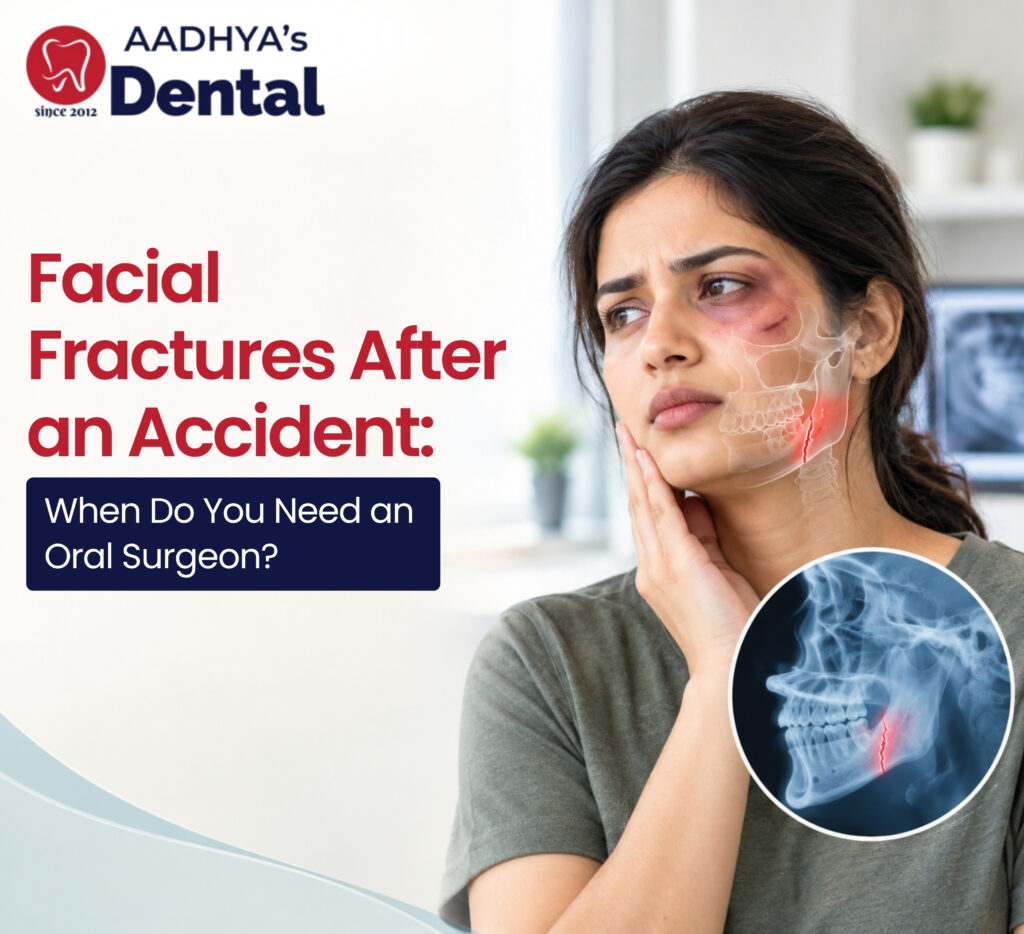
A road traffic accident, sports injury, fall, or blow to the face can cause much more than a visible cut or swelling. Sometimes, an accident can fracture the bones of the jaw, cheek, nose, eye socket, or other parts of the face.
While a small cut or bruise may heal with basic care, a facial fracture requires proper assessment because untreated fractures can affect chewing, speaking, breathing, vision, facial symmetry, and even the way your teeth fit together.
So, when should you see an oral surgeon after a facial injury?
If you have experienced significant trauma to the face, particularly after a road traffic accident in Hyderabad, a fall, sports injury, or any direct blow to the jaw or face, it is important to have the injury evaluated by a qualified Oral and Maxillofacial Surgeon.
At Aadhya’s Dental, Nallagandla, patients can consult an experienced in-house Oral & Maxillofacial Surgeon and Implantologist, Dr. P. Krishna Kishore, for evaluation and management of facial trauma and jaw-related injuries.
What Is a Facial Fracture?
A facial fracture is a break or crack in one or more of the bones that make up the face.
Depending on the type and severity of trauma, fractures can involve:
- Upper or lower jaw
- Cheekbone
- Nose
- Eye socket
- Midface
- Jaw joint area
- Facial bones around the mouth and teeth
Some fractures are obvious, while others may be difficult to detect without clinical examination and appropriate imaging.
For example, you may not see a major deformity even when there is a fracture of the jaw or cheekbone.
That is why facial trauma should not be judged only by how the face looks from the outside.
Common Causes of Facial Fractures
Facial fractures can occur due to several types of trauma.
Road traffic accidents
Motorcycle and car accidents are important causes of facial injuries. A direct impact to the face, steering wheel, dashboard, helmet, or road surface can cause fractures of the jaw and midface.
Falls
A fall from stairs, a bicycle, workplace accident, or other height can result in facial fractures, particularly when the face or chin takes the impact.
Sports injuries
Contact sports and accidental collisions can cause fractures involving the nose, cheekbone, jaw, or eye socket.
Physical trauma
A direct blow to the face can fracture facial bones depending on the force and direction of the impact.
Workplace injuries
Industrial and occupational accidents can sometimes result in significant facial trauma requiring specialist evaluation.
Signs You May Have a Facial Fracture
Not every facial fracture produces dramatic symptoms.
However, certain signs should make you seek medical or dental evaluation promptly.
1. Difficulty opening or closing your mouth
If you suddenly cannot open your mouth normally after an accident, there could be an injury involving the jaw or surrounding structures.
2. Your teeth no longer fit together properly
This is one of the important signs following jaw trauma.
If your bite feels different after an accident—such as the teeth touching differently on one side or not meeting normally—you should get evaluated.
3. Loose or displaced teeth
Trauma can damage teeth as well as the surrounding bone. A tooth may become loose, displaced, fractured, or completely knocked out.
4. Swelling and bruising
Significant swelling or bruising around the jaw, cheek, nose, or eyes may accompany a fracture.
5. Numbness of the face or lip
Injury to facial bones can sometimes affect nearby nerves, causing numbness or altered sensation.
Numbness around the lower lip or chin after a jaw injury, for example, should not be ignored.
6. Facial asymmetry
If one side of your face appears different after an accident, it may indicate displacement of an underlying facial bone.
7. Bleeding from the mouth or nose
Bleeding following significant facial trauma requires proper assessment, particularly when accompanied by swelling, deformity, or difficulty breathing.
8. Difficulty chewing
Pain or difficulty while biting and chewing may indicate an injury to the jaw, teeth, or supporting structures.
9. Vision problems
Blurry vision, double vision, pain around the eye, or difficulty moving the eye after facial trauma requires urgent medical assessment.
10. Persistent facial pain
Pain that continues or becomes worse after an accident should be evaluated rather than simply managed with painkillers.
When Should You See an Oral Surgeon After an Accident?
You should consider an evaluation by an Oral and Maxillofacial Surgeon when facial trauma involves the jaw, teeth, mouth, cheekbones, or other facial structures.
An oral surgeon is particularly important when there is:
- Suspected jaw fracture
- Facial bone fracture
- Severe facial swelling
- Change in your bite
- Difficulty opening the mouth
- Jaw movement problems
- Facial numbness
- Displaced teeth
- Multiple dental injuries
- Persistent bleeding
- Significant facial wounds
- Suspected injury around the jaw joint
- Facial asymmetry after trauma
An oral and maxillofacial surgeon is trained to diagnose and manage injuries involving the mouth, jaws, face and associated structures.
Why Is the Bite So Important After a Jaw Injury?
One of the simplest things you can check after a facial injury is whether your teeth come together the way they normally did before the accident.
Your bite is influenced by the position of your jaws.
If a fracture has caused displacement of the jawbone, the teeth may no longer meet correctly.
Patients may notice:
“My teeth don’t come together the same way.”
or
“My bite feels completely different after the accident.”
This can be an important warning sign.
A specialist examination can determine whether the change is due to swelling, dental injury, jaw displacement, or another problem.
What Does an Oral Surgeon Do for Facial Fractures?
The first step is a detailed assessment.
Depending on the injury, the oral surgeon may evaluate:
- Facial symmetry
- Jaw movement
- Bite relationship
- Teeth and gums
- Facial sensation
- Mouth opening
- Areas of tenderness
- Swelling and bruising
- Eye and surrounding structures
- Signs of infection or soft-tissue injury
Imaging may also be recommended to determine whether a fracture is present and understand its location and severity.
The treatment depends on the type of fracture.
Some fractures can be managed conservatively with observation, medication, dietary modification and follow-up.
Other fractures may require a surgical procedure to reposition and stabilize the fractured bones.
Do All Facial Fractures Need Surgery?
No.
This is an important point for patients and families to understand.
A facial fracture does not automatically mean that surgery is required.
Treatment depends on factors such as:
- Location of the fracture
- Degree of displacement
- Stability of the fracture
- Effect on the bite
- Functional problems
- Associated injuries
- Soft-tissue damage
- Patient’s overall health
Some minimally displaced and stable fractures may be managed without surgery.
However, displaced fractures or injuries causing significant functional problems may require surgical intervention.
Your oral surgeon can explain the options after evaluating the fracture.
What Is Facial Fracture Surgery?
When surgery is necessary, the objective is generally to restore the normal position and stability of the affected facial bones while preserving function and appearance.
Depending on the fracture, treatment may involve repositioning the bone and securing it using appropriate fixation methods.
For jaw fractures, restoring the correct relationship between the upper and lower teeth is particularly important.
The exact procedure depends on the fracture pattern and the bones involved.
Because facial anatomy is complex, treatment planning needs to be individualized.
What Happens If a Facial Fracture Is Left Untreated?
Some minor fractures heal appropriately with conservative management.
However, an untreated or improperly healed significant fracture can potentially result in:
- Persistent change in bite
- Difficulty chewing
- Restricted mouth opening
- Facial asymmetry
- Chronic pain
- Altered sensation or numbness
- Jaw function problems
- Improper bone healing
- Infection in certain cases
This is why it is not advisable to simply wait for severe swelling or pain to disappear after a significant accident.
Early assessment helps determine whether treatment is necessary.
Facial Trauma Can Also Damage the Teeth
A facial injury may involve both the bones and teeth.
Following an accident, you may experience:
- Chipped teeth
- Cracked teeth
- Root fractures
- Loose teeth
- Displaced teeth
- Tooth intrusion
- Tooth avulsion
- Damage to the gums or supporting bone
A facial trauma assessment should therefore include an evaluation of the teeth and surrounding structures.
In some cases, dental treatment may need to be coordinated with fracture management.
What Should You Do Immediately After a Facial Injury?
If you have experienced significant facial trauma:
Stay calm and avoid unnecessary movement
Try not to repeatedly open and close the jaw to “test” it.
Control visible bleeding
Apply gentle pressure with clean gauze when appropriate.
Use a cold pack for swelling
A cold compress wrapped in cloth can help reduce swelling during the early period after injury.
Avoid hard foods
If jaw injury is suspected, avoid chewing hard or crunchy foods until you have been evaluated.
Do not attempt to straighten the jaw yourself
Manipulating a suspected fracture can worsen the injury.
Seek professional assessment
Significant facial trauma should be evaluated by an appropriate medical or dental specialist.
If there is difficulty breathing, loss of consciousness, severe bleeding, major eye symptoms, or other signs of a potentially life-threatening injury, emergency medical care should be sought immediately
Facial Fracture Treatment in Nallagandla, Hyderabad
For patients searching for an oral surgeon in Nallagandla, access to specialist care can make the evaluation process more convenient after an accident.
Aadhya’s Dental, Nallagandla, provides access to an in-house Oral & Maxillofacial Surgeon and Implantologist, Dr. P. Krishna Kishore, who manages oral surgical conditions and facial trauma-related cases.
The clinic can be a convenient option for patients from nearby areas such as:
- Nallagandla
- Tellapur
- Lingampally
- Gachibowli
- Gopanpally
- BHEL
- Miyapur
- HCU
- Financial District
- Kondapur and surrounding areas
If you are searching online for an oral surgeon near Tellapur, facial fracture treatment near Gachibowli, jaw fracture treatment in Hyderabad, or an oral surgery clinic near Lingampally, getting evaluated promptly is more important than delaying treatment while trying to determine the exact diagnosis yourself.
Why Choose an Oral & Maxillofacial Surgeon for Facial Trauma?
Facial trauma can involve several interconnected structures—the teeth, jaws, facial bones, nerves, muscles and soft tissues.
An Oral & Maxillofacial Surgeon has specialized training in surgical conditions affecting the face, jaws and mouth.
This is particularly useful when an injury involves both dental and facial structures.
At Aadhya’s Dental, patients can access specialist oral surgical care along with general dental services under one roof.
The presence of an in-house specialist also helps patients understand whether their injury requires conservative management, further imaging, dental treatment, or surgical intervention.
Frequently Asked Questions About Facial Fractures
How do I know if my jaw is fractured after an accident?
Difficulty opening the mouth, facial swelling, jaw pain, facial numbness, loose teeth, facial asymmetry, or a sudden change in your bite can be signs of a jaw fracture. Imaging is usually required to confirm the diagnosis.
Can a facial fracture heal without surgery?
Yes. Some stable and minimally displaced fractures can be managed without surgery. More complex or displaced fractures may require surgical treatment.
Is a change in bite after an accident serious?
A new change in the way your teeth meet after facial trauma can indicate an injury involving the jaw or surrounding structures and should be evaluated.
Should I see a dentist or an oral surgeon after facial trauma?
For minor tooth injuries, a dentist may be appropriate. If there is suspected jaw or facial bone involvement, an Oral & Maxillofacial Surgeon is better equipped to evaluate the injury.
Can facial fractures affect appearance?
Yes. Displaced facial fractures can sometimes alter facial symmetry. Appropriate diagnosis and treatment aim to restore both function and facial structure.
How soon should I get checked after a facial injury?
If you have significant trauma or symptoms suggesting a fracture, seek evaluation promptly rather than waiting for the swelling or pain to disappear.
Don’t Ignore Facial Trauma After an Accident
A facial injury can sometimes look less serious on the outside than it actually is.
If you notice a change in your bite, difficulty opening your mouth, facial numbness, significant swelling, loose teeth, persistent pain, or facial asymmetry after an accident, don’t ignore the symptoms.
Early assessment can help identify fractures and associated dental injuries and determine whether you need observation, dental treatment, or specialist surgical care.
For patients looking for an oral surgeon in Nallagandla, facial fracture treatment near Tellapur, jaw fracture treatment near Gachibowli, or an oral surgery clinic near Lingampally, Aadhya’s Dental, Nallagandla provides access to an in-house Oral & Maxillofacial Surgeon and Implantologist, Dr. P. Krishna Kishore, for specialist evaluation of oral and facial injuries.
After an accident, don’t wait for a facial injury to “settle down” if something feels different. Get it evaluated and let the diagnosis guide the treatment.