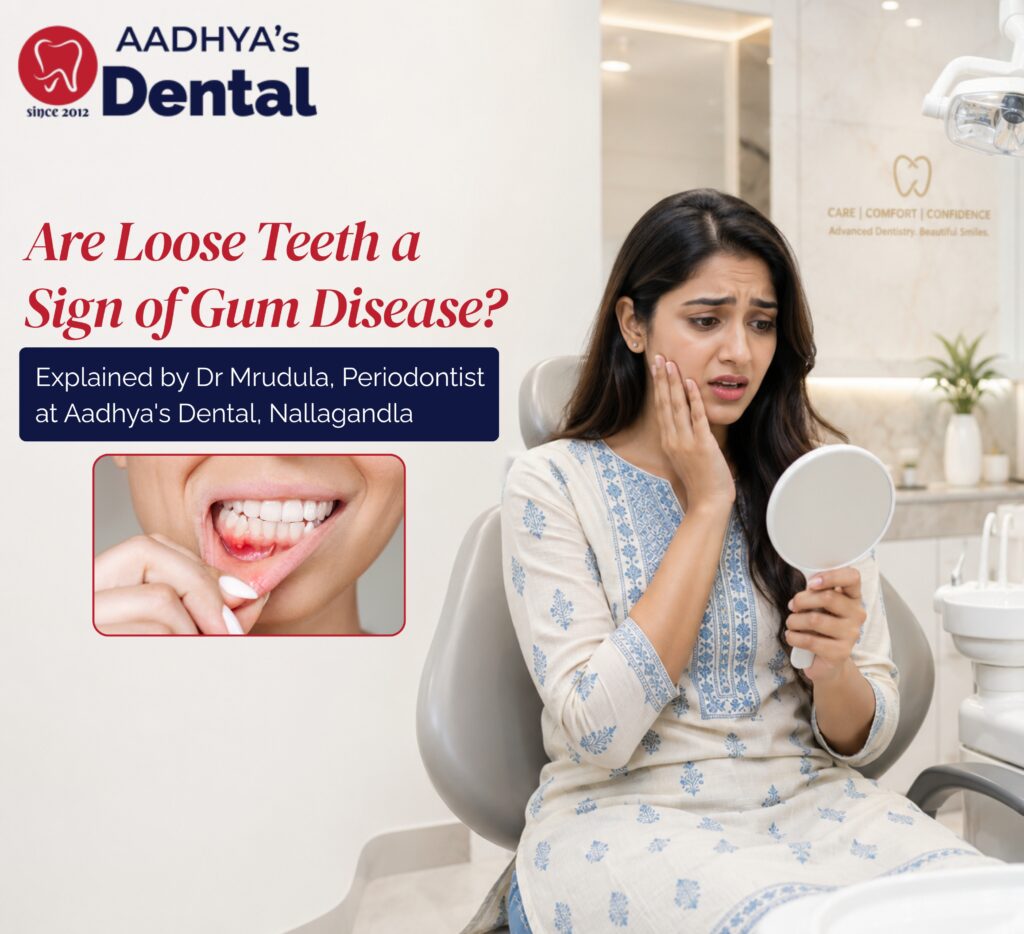
Have you noticed that one or more of your teeth feel loose while eating or brushing? Many people assume it’s a normal part of ageing, but the truth is that loose teeth in adults are never normal. In most cases, they can be an early or advanced sign of gum disease (periodontal disease).
I’m Dr Mrudula, a Periodontist at Aadhya’s Dental, Nallagandla, and one of the most common questions I hear from patients in Nallagandla, Tellapur, Lingampally, BHEL, Gopanpally, Osman Nagar, Kollur, Miyapur, Chandanagar, and Kondapur is:
“Doctor, why are my teeth becoming loose? Can they be saved?”
The good news is that if gum disease is diagnosed early, loose teeth can often be stabilised and preserved. Let’s understand why teeth become loose, what gum disease has to do with it, and when you should seek professional treatment.
Why Do Teeth Become Loose?
Healthy teeth are firmly held in place by:
- Healthy gums
- Jawbone
- Periodontal ligament (fibres supporting the tooth)
- Cementum surrounding the root
When these supporting structures become damaged, teeth begin to lose their stability.
One of the leading causes of this damage is periodontal (gum) disease.
If left untreated, the infection gradually destroys the bone that supports your teeth, eventually leading to tooth mobility and even tooth loss.
For More Info: https://aadhyasdental.com/best-pediatric-dental-care-in-nallagandla-gentle-advanced-kids-dentistry-at-aadhyas-dental/
Is a Loose Tooth Always a Sign of Gum Disease?
Not always—but in adults, gum disease is the most common cause.
Other possible reasons include:
- Dental trauma
- Teeth grinding (Bruxism)
- Bite problems
- Severe tooth infection
- Osteoporosis
- Hormonal changes
- Injury during sports or accidents
However, if loose teeth are accompanied by swollen gums or bleeding while brushing, gum disease is highly likely.
What is Gum Disease?
Gum disease is a bacterial infection affecting the gums and supporting bone around the teeth.
It usually progresses in two stages:
Stage 1: Gingivitis
At this stage:
- Gums become red
- Swelling develops
- Bleeding occurs during brushing
- Bad breath develops
The good news is that gingivitis is completely reversible with professional cleaning and proper oral hygiene.
Stage 2: Periodontitis
If gingivitis is ignored, it progresses into periodontitis.
During this stage:
- Gum pockets develop
- Bone starts shrinking
- Teeth lose support
- Teeth gradually become loose
- Tooth loss becomes a possibility
Unfortunately, bone loss cannot grow back naturally without specialised periodontal treatment.
How Does Gum Disease Cause Loose Teeth?
Here’s what happens step by step:
Step 1
Plaque accumulates around teeth.
Step 2
Bacteria produce toxins.
Step 3
The gums become infected.
Step 4
The infection spreads beneath the gums.
Step 5
The jawbone starts dissolving.
Step 6
Less bone means less support.
Step 7
Teeth begin to move or become loose.
Many patients don’t notice this process because it happens slowly over several years.
Early Signs of Gum Disease You Should Never Ignore
Watch out for these warning signs:
- Bleeding gums while brushing
- Persistent bad breath
- Swollen gums
- Red or tender gums
- Gum recession
- Longer-looking teeth
- Food getting stuck frequently
- Loose teeth
- Pain while chewing
- Pus around the gums
If you notice even two or three of these symptoms, it’s time to visit a periodontist.
Can Loose Teeth Be Saved?
Yes—in many cases.
The treatment depends on how much bone support remains.
Early intervention significantly improves the chances of saving natural teeth.
Periodontal Treatments That Can Help Save Loose Teeth
At Aadhya’s Dental, Nallagandla, Dr Mrudula provides comprehensive periodontal care using advanced diagnostic techniques.
Treatment may include:
Professional Scaling
Professional cleaning removes plaque and tartar above and below the gums.
This is the first step in treating gum disease.
Root Planing
Deep cleaning smooths the root surfaces and removes bacteria hiding beneath the gums.
This helps gums reattach to the tooth.
Flap Surgery
In advanced gum disease, flap surgery allows direct access to remove deep infection and clean the roots thoroughly.
This significantly reduces bacterial load.
Bone Grafting
If bone loss has occurred, bone grafting may help regenerate lost supporting bone in selected cases.
Guided Tissue Regeneration
Advanced regenerative procedures encourage the body’s natural healing process to rebuild lost tissues.
Splinting Loose Teeth
Loose teeth can sometimes be stabilised by joining them with neighbouring healthy teeth.
This improves comfort while eating and helps protect the affected teeth during healing.
Can Loose Teeth Tighten Again?
This depends on:
- Amount of bone remaining
- Severity of gum disease
- Patient’s oral hygiene
- Smoking habits
- Diabetes control
- Timely treatment
Many patients experience significant improvement after periodontal therapy, especially when treatment begins before severe bone loss occurs.
Who is More Likely to Develop Gum Disease?
You may be at higher risk if you:
- Smoke or chew tobacco
- Have diabetes
- Brush improperly
- Skip dental cleanings
- Have a family history of gum disease
- Experience hormonal changes
- Grind your teeth
- Have poor oral hygiene
How to Prevent Loose Teeth
Simple preventive measures include:
- Brush twice daily using the correct technique
- Floss every day
- Use an antibacterial mouthwash if recommended
- Visit your dentist every six months
- Get professional scaling regularly
- Control diabetes
- Avoid smoking and tobacco
- Eat a balanced diet rich in vitamins and minerals
Why Choose Dr Mrudula at Aadhya’s Dental, Nallagandla?
If you’re searching online for:
- Best periodontist in Nallagandla
- Loose tooth treatment near Tellapur
- Gum specialist near Lingampally
- Periodontal treatment in Nallagandla
- Gum disease treatment near Gopanpally
- Flap surgery specialist near Tellapur
- Scaling and root planing in Nallagandla
- Best dental clinic near Tellapur
- Gum infection treatment near Osman Nagar
- Periodontist near Kondapur
Dr Mrudula at Aadhya’s Dental, Nallagandla, offers personalised periodontal care focused on preserving your natural teeth whenever possible. Patients from Tellapur, Lingampally, Gopanpally, Osman Nagar, Kollur, BHEL, Chandanagar, Miyapur, Kondapur, and nearby areas trust the clinic for comprehensive diagnosis, advanced gum treatments, and long-term preventive care.
Frequently Asked Questions (FAQs)
1. Are loose teeth always caused by gum disease?
No. Loose teeth can also result from trauma, teeth grinding, bite issues, or infections. However, in adults, gum disease is the most common cause.
2. Can a loose tooth become firm again?
Yes. If treated early, periodontal therapy can reduce inflammation, stabilise the tooth, and prevent further bone loss. The outcome depends on the amount of remaining bone support.
3. Is bleeding while brushing normal?
No. Healthy gums should not bleed during brushing or flossing. Bleeding is often one of the earliest signs of gum disease.
4. Does gum disease cause bad breath?
Yes. Persistent bad breath is commonly caused by bacteria trapped beneath the gums and is a frequent symptom of periodontal disease.
5. Is flap surgery painful?
Flap surgery is performed under local anaesthesia, making the procedure comfortable. Mild discomfort afterwards is usually manageable with prescribed medications and proper aftercare.
6. Can gum disease lead to tooth loss?
Yes. If left untreated, gum disease can destroy the bone supporting the teeth, eventually resulting in tooth mobility and tooth loss.
7. How often should I have professional dental cleaning?
Most people benefit from professional scaling every six months. Patients with gum disease may require more frequent maintenance visits, as recommended by their periodontist.
8. Do loose teeth always need to be extracted?
Not necessarily. Many loose teeth can be preserved with timely periodontal treatment, provided there is sufficient supporting bone and the infection is controlled.
9. Does diabetes increase the risk of gum disease?
Yes. Poorly controlled diabetes increases the risk of gum infections and can slow the healing process. Maintaining good blood sugar control is essential for healthy gums.
10. When should I visit a periodontist?
If you experience bleeding gums, swollen gums, persistent bad breath, gum recession, loose teeth, or discomfort while chewing, schedule a periodontal evaluation as soon as possible.
Conclusion
Loose teeth are not a normal part of ageing and should never be ignored. In many adults, they are a warning sign of advanced gum disease, where the infection has already begun affecting the bone that supports the teeth. The sooner periodontal disease is diagnosed, the greater the chance of preserving your natural smile.
If you’ve noticed bleeding gums, gum recession, bad breath, or loose teeth, don’t wait until the condition worsens. Consult Dr Mrudula, Periodontist at Aadhya’s Dental, Nallagandla, for a comprehensive gum health evaluation and personalised treatment plan. Patients from Nallagandla, Tellapur, Lingampally, Gopanpally, Osman Nagar, Kollur, BHEL, Chandanagar, Miyapur, Kondapur, and surrounding areas rely on expert periodontal care to protect their gums, save their teeth, and maintain long-term oral health.
Book your consultation today Call: +91-7396235802 and take the first step toward healthier gums and stronger teeth.