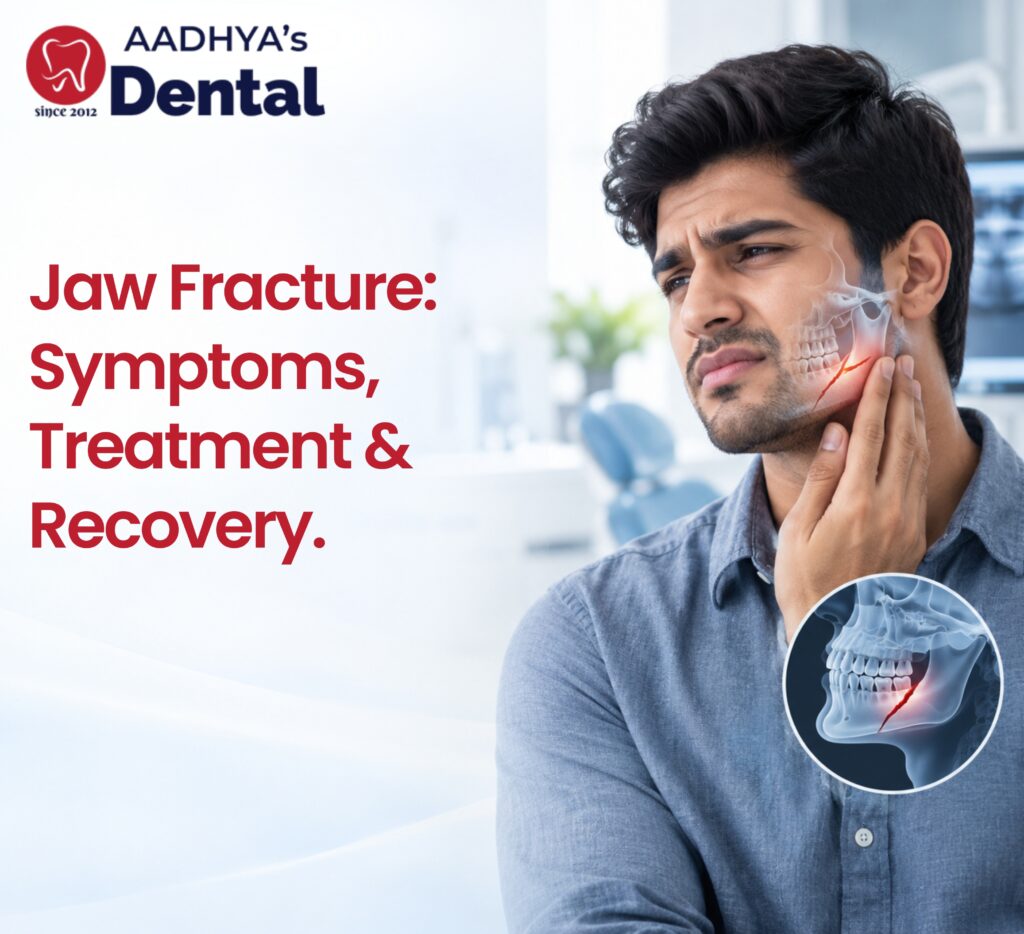
A sudden fall, road traffic accident, sports injury, or blow to the face can cause more than just a bruise. In some cases, the force of an injury can fracture the jawbone. A jaw fracture, also called a mandibular fracture when it affects the lower jaw, can interfere with eating, speaking, opening the mouth, and even the way your teeth fit together.
Because the jaw is involved in both facial structure and everyday functions, a suspected fracture should not be ignored.
At Aadhya’s Dental, Nallagandla, Hyderabad, jaw and facial injuries can be evaluated by Dr. P. Krishna Kishore, Oral & Maxillofacial Surgeon and Implantologist, an in-house specialist experienced in oral and maxillofacial surgical procedures. His specialist assessment can help determine the extent of the injury and the appropriate treatment approach.
What Is a Jaw Fracture?
A jaw fracture is a break or crack in one of the bones forming the jaw.
Jaw fractures commonly involve the mandible (lower jaw), although fractures can also occur in the upper jaw and other facial bones.
The location and severity of the fracture can vary significantly. Some fractures are relatively straightforward, while others may involve multiple fracture lines, displaced bone segments, damaged teeth, or associated facial injuries.
A fracture may occur after:
- Road traffic accidents
- Falls
- Sports injuries
- Physical trauma
- Bicycle or motorcycle accidents
- Direct blows to the face
- Workplace injuries
- Other significant facial trauma
Not every jaw injury is obvious from the outside. A person may have a fracture even when there is relatively little swelling or bruising.
What Are the Symptoms of a Jaw Fracture?
The symptoms depend on where the fracture has occurred and how severe it is.
Common signs can include:
1. Jaw Pain
Pain around the jaw, chin, cheek, or face is one of the most common symptoms. The pain may become worse when chewing, speaking, or attempting to open the mouth.
2. Swelling
Swelling around the jaw or face can develop following an injury. Bruising may also occur.
3. Difficulty Opening the Mouth
Some patients experience restricted mouth opening after a jaw injury. This can make eating, speaking, or brushing difficult.
4. Change in the Way Your Teeth Meet
One of the more important warning signs is a sudden change in your bite.
You may notice that your upper and lower teeth no longer come together in the way they normally did before the injury.
This can happen when fractured jaw segments have shifted.
5. Loose or Damaged Teeth
Trauma can loosen, fracture, displace, or completely knock out teeth.
6. Numbness
A fracture of the lower jaw can sometimes affect the nerve that supplies sensation to the lower lip and chin, resulting in numbness or altered sensation.
7. Bleeding Inside the Mouth
Cuts or bleeding around the gums, tongue, or inside of the cheek may accompany a jaw fracture.
8. Difficulty Chewing or Speaking
Pain, swelling, altered bite, or movement of the fractured jaw can make normal chewing and speaking uncomfortable.
9. Abnormal Movement
In some fractures, movement may be felt in an area of the jaw where movement should not normally occur.
When Should You See a Jaw Fracture Specialist?
If you have experienced significant facial trauma and develop jaw pain, swelling, difficulty opening your mouth, numbness, loose teeth, or a change in your bite, it is important to seek professional evaluation.
A particularly important warning sign is:
“My teeth don’t come together the way they used to after the injury.”
This may indicate that the position of the jaw has changed.
If there is significant facial trauma, don’t try to force the jaw back into position yourself.
How Is a Jaw Fracture Diagnosed?
Diagnosis usually begins with a detailed clinical examination.
An Oral & Maxillofacial Surgeon evaluates the injury by checking:
- Jaw movement
- Bite alignment
- Facial symmetry
- Areas of tenderness
- Nerve sensation
- Tooth injuries
- Soft-tissue injuries
- Mouth opening
- Signs of infection or other complications
Imaging may then be recommended to understand the fracture in greater detail.
Depending on the injury, this can include dental X-rays or CBCT/CT imaging.
Three-dimensional imaging can be particularly useful for understanding the location, direction and displacement of complex facial fractures.
Does Every Jaw Fracture Need Surgery?
No.
The treatment depends on the location and severity of the fracture, whether the bone fragments have moved, the patient’s bite, associated injuries and several other factors.
Some fractures can be managed conservatively with close monitoring, dietary modifications and appropriate supportive care.
Other fractures require surgical treatment to reposition and stabilize the broken bone.
The decision should be made after proper clinical and radiographic evaluation.
How Are Jaw Fractures Treated?
Jaw fracture treatment can broadly involve either non-surgical management or surgical fixation.
Non-Surgical Treatment
In selected uncomplicated fractures, the surgeon may recommend conservative treatment.
This can involve:
- Soft or liquid diet
- Pain management
- Avoiding pressure on the jaw
- Regular follow-up
- Monitoring healing
- Maintaining appropriate oral hygiene
The exact restrictions and duration depend on the fracture.
Surgical Treatment
When the fracture is displaced, unstable, significantly affects the bite, or meets other surgical criteria, open reduction and internal fixation (ORIF) may be considered.
During this procedure, the fractured bone segments are carefully repositioned and stabilized, often using plates and screws designed for maxillofacial surgery.
The objective is to restore appropriate alignment and allow the bone to heal in a stable position.
Why Is Correct Bite Alignment Important?
Your teeth don’t simply meet randomly.
The upper and lower jaws have a specific relationship that allows you to chew, speak and function comfortably.
A jaw fracture that heals in an incorrect position can result in a persistent change in the bite.
This is why jaw fracture treatment involves much more than simply “joining the broken bone.”
The surgeon must consider the relationship between the jaws, teeth, facial structure and function.
This is one of the reasons why evaluation by an Oral & Maxillofacial Surgeon is important in significant jaw and facial trauma.
Jaw Fracture Treatment at Aadhya’s Dental, Nallagandla
If you are searching for a jaw fracture specialist in Nallagandla, oral and maxillofacial surgeon near Tellapur, or a facial trauma specialist near Gachibowli, having access to a specialist can make a significant difference in evaluating complex injuries.
At Aadhya’s Dental, Nallagandla, Dr. P. Krishna Kishore, Oral & Maxillofacial Surgeon and Implantologist, provides specialist evaluation for oral and facial surgical conditions.
His expertise includes the assessment and management of various maxillofacial conditions and facial trauma.
For patients from Nallagandla, Tellapur, Lingampally, BHEL, Gopanpally, Gachibowli, Miyapur and surrounding areas, Aadhya’s Dental provides access to an in-house oral and maxillofacial surgical specialist.
What Happens During Recovery From a Jaw Fracture?
Recovery depends on the type of fracture and the treatment provided.
During the healing period, patients may need to follow dietary and activity restrictions recommended by their surgeon.
Diet
Depending on the treatment, you may initially need a liquid or soft diet.
Foods should be easy to consume without placing excessive pressure on the healing jaw.
Your surgeon will advise when and how gradually to return to a normal diet.
Oral Hygiene
Keeping the mouth clean is important, particularly when there are cuts, stitches, dental injuries, or surgical wounds.
Your surgeon or dentist may recommend specific oral hygiene measures during recovery.
Avoid Smoking and Tobacco
Smoking and tobacco use can interfere with healing and increase the risk of complications.
Avoiding tobacco during recovery is strongly recommended.
Follow-Up Visits
Follow-up appointments allow the surgeon to monitor healing, bite alignment, jaw function and any potential complications.
Do not skip follow-up appointments simply because the pain has improved.
How Long Does a Jaw Fracture Take to Heal?
Healing time varies according to the patient’s age, general health, fracture location, severity, treatment method and other factors.
The bone may require several weeks to heal, while complete functional recovery can take longer.
Your surgeon will determine when it is safe to gradually return to normal chewing and other activities.
Do not assume that because the jaw feels better, it is ready for unrestricted use.
Can a Jaw Fracture Affect Your Teeth?
Yes.
A facial injury can damage both the jawbone and the teeth.
Teeth may become:
- Loose
- Fractured
- Displaced
- Intruded
- Knocked out
- Sensitive after trauma
Some dental injuries may require additional treatment after the jaw fracture has been stabilized.
Depending on the situation, this could include splinting, root canal treatment, restorations, extraction, or replacement of damaged teeth.
A comprehensive evaluation helps ensure that tooth injuries are not overlooked.
Can You Prevent Jaw Fractures?
Not every accident can be prevented, but certain precautions can reduce the risk of serious facial injuries.
These include:
- Wearing a properly fitted helmet while riding
- Using appropriate protective equipment during contact sports
- Wearing a seat belt in cars
- Following workplace safety precautions
- Using appropriate protective mouthguards for certain sports
Why Choose an Oral & Maxillofacial Surgeon for Jaw Fractures?
Jaw fractures are not simply dental problems.
They involve bone, teeth, nerves, muscles, facial structures and bite alignment.
An Oral & Maxillofacial Surgeon is specifically trained in surgical conditions involving the mouth, jaws, face and associated structures.
At Aadhya’s Dental, Dr. P. Krishna Kishore, Oral & Maxillofacial Surgeon and Implantologist, provides specialist expertise for patients requiring evaluation of jaw and facial injuries.
For complicated injuries, his role may involve assessing the fracture pattern, reviewing imaging, determining whether surgery is required, planning the procedure and monitoring recovery.
Frequently Asked Questions About Jaw Fractures
Can a jaw fracture heal on its own?
Some uncomplicated fractures may be managed without surgery under specialist supervision. However, a displaced or unstable fracture may require surgical stabilization. A proper examination and imaging are necessary before deciding.
How do I know if my jaw is fractured?
Pain, swelling, difficulty opening the mouth, numbness, loose teeth, bleeding and a sudden change in your bite can all be warning signs. However, symptoms alone cannot confirm a fracture. Imaging may be required.
Is jaw fracture surgery painful?
Jaw fracture surgery is performed with appropriate anesthesia. Some discomfort, swelling and soreness can occur after surgery, but your surgeon will provide appropriate postoperative instructions and medications.
Can I eat normally after jaw fracture surgery?
Usually, patients need dietary restrictions during the early healing period. Your Oral & Maxillofacial Surgeon will advise you when it is safe to progress from liquids to soft foods and eventually to a normal diet.
How long does jaw fracture recovery take?
Bone healing generally takes several weeks, but the overall recovery period varies. The fracture pattern, treatment method, general health and adherence to postoperative instructions all influence recovery.
Can a jaw fracture cause permanent numbness?
Numbness can occur when a fracture affects a nerve. In many cases sensation improves over time, but recovery varies. Your surgeon can assess the nerve involvement and explain the expected prognosis.
Where can I consult an Oral & Maxillofacial Surgeon for a jaw fracture near Tellapur?
Patients looking for a jaw fracture specialist near Tellapur, Nallagandla, Lingampally or Gachibowli can consult Dr. P. Krishna Kishore, Oral & Maxillofacial Surgeon and Implantologist, at Aadhya’s Dental, Nallagandla.
Final Thoughts
A jaw fracture should never be treated as “just another dental injury.”
The jaw plays an important role in chewing, speaking, facial appearance and the alignment of your teeth. Getting the right diagnosis and treatment early can help support proper healing and reduce the risk of long-term functional problems.
If you or a family member has suffered facial trauma and is experiencing jaw pain, swelling, difficulty opening the mouth, numbness, loose teeth or a change in bite, seek professional evaluation rather than waiting for the symptoms to settle.
At Aadhya’s Dental, Nallagandla, Dr. P. Krishna Kishore, Oral & Maxillofacial Surgeon and Implantologist, provides in-house specialist evaluation and surgical expertise for jaw and facial conditions.
For patients searching for a jaw fracture specialist in Nallagandla, Oral & Maxillofacial Surgeon near Tellapur, facial trauma specialist near Gachibowli, or oral surgeon in Hyderabad, Aadhya’s Dental offers specialist-led evaluation in a convenient Nallagandla location.