This is a common concern among patients who have been missing their upper teeth for many years. Bone loss can occur gradually after tooth loss, and in some patients, the amount of bone available in the upper jaw may not be sufficient for conventional implants.
Fortunately, having severe bone loss does not always mean that you have to settle for removable dentures.
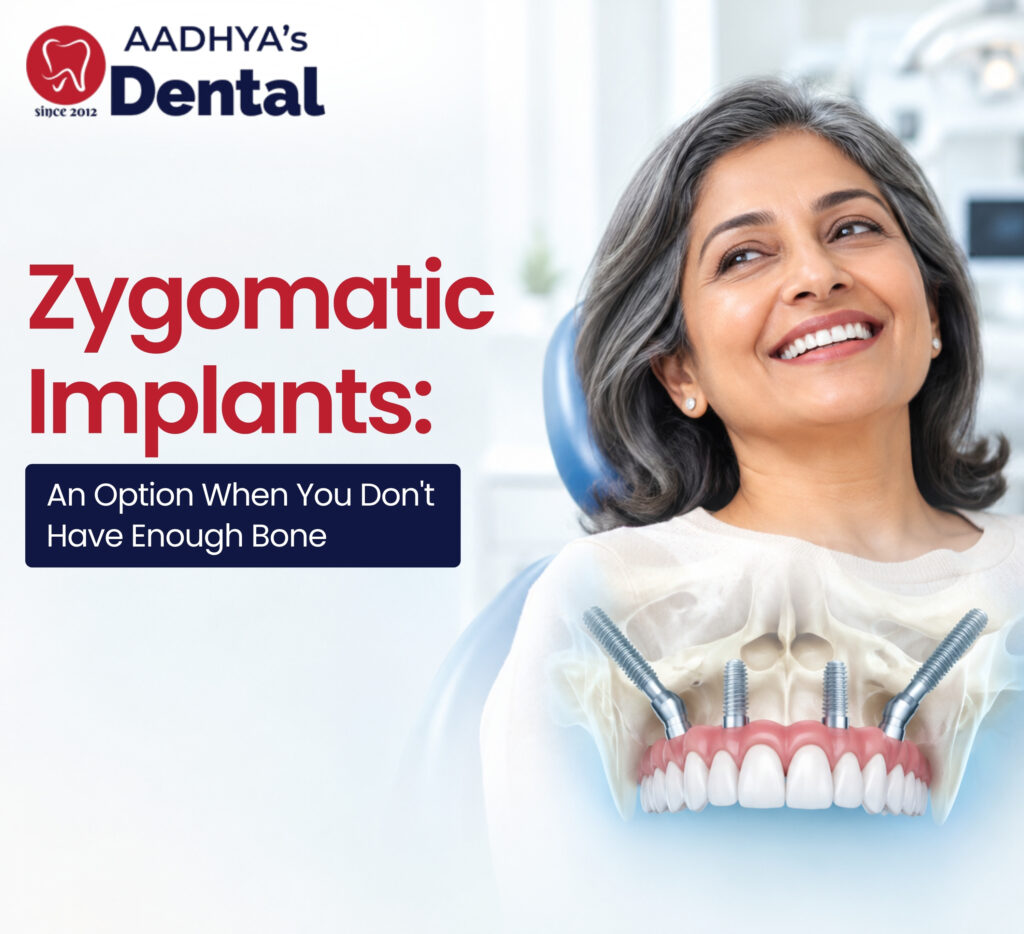
Zygomatic implants are an advanced implant treatment option that can be considered in carefully selected patients with severe bone loss in the upper jaw.
At Aadhya’s Dental, Nallagandla, Hyderabad, patients can benefit from the expertise of an in-house specialist team, including Dr Mrudula, Periodontist and Oral Implantologist, and Dr P. Krishna Kishore, Oral & Maxillofacial Surgeon and Implantologist. Their combined expertise allows complex implant cases to be assessed from both gum-health and surgical perspectives.
What Are Zygomatic Implants?
Unlike conventional dental implants, which are usually placed into the jawbone, zygomatic implants are anchored in the zygomatic bone, commonly known as the cheekbone.
The zygomatic bone is denser and generally provides a more stable foundation in patients who have experienced significant bone loss in the upper jaw.
This makes zygomatic implants a potential treatment option for people who have:
- Severe bone loss in the upper jaw
- Very little bone available for conventional implants
- Experienced long-term tooth loss
- Previously worn dentures
- Failed conventional implant treatment
- Significant bone resorption following tooth loss
- Anatomical limitations that make conventional implant placement difficult
However, zygomatic implants are not suitable for everyone. A detailed clinical examination and three-dimensional imaging are essential before deciding whether this treatment is appropriate.
Why Does Bone Loss Happen After Losing Teeth?
Many patients assume that once a tooth is removed, the bone underneath remains unchanged. Unfortunately, this isn’t the case.
The jawbone needs stimulation from the tooth roots. After a tooth is lost, the surrounding bone can gradually shrink over time. When multiple teeth have been missing for years, this bone loss can become significant.
In the upper jaw, bone loss can sometimes be accompanied by enlargement of the maxillary sinus, leaving very limited bone height for conventional dental implants.
This is why a patient who lost teeth many years ago may be told that they “don’t have enough bone” for regular implants.
But insufficient bone does not automatically mean that dental implants are impossible.
Depending on the individual situation, treatment options may include bone grafting, sinus augmentation, conventional implants, tilted implants, or in selected cases, zygomatic implants.
Who May Need Zygomatic Implants?
Zygomatic implants are generally considered for patients with severe upper-jaw bone deficiency.
For example, they may be considered when conventional implants cannot be placed safely because there is inadequate bone volume.
They can also be considered in some patients who have already undergone unsuccessful implant treatment or extensive bone loss following long-term denture use.
The important point is that zygomatic implants are an advanced treatment option, not simply a replacement for conventional implants.
A specialist needs to evaluate the patient’s bone anatomy, sinus anatomy, general oral health, gum condition, bite, expectations and overall suitability before recommending this procedure.
Zygomatic Implants vs Conventional Dental Implants
The main difference is where the implant gets its support.
Conventional dental implants are generally placed into the available jawbone.
Zygomatic implants, on the other hand, use the stronger zygomatic or cheekbone region for anchorage.
This difference can make zygomatic implants useful in situations where there is inadequate bone in the conventional implant area.
Importantly, this does not mean that zygomatic implants are “better” than regular implants.
They are designed for different clinical situations.
If a patient has sufficient bone for conventional implants, standard implants may remain the preferred and simpler option. Zygomatic implants are usually considered when conventional implant placement is severely limited by bone loss.
More Info: https://aadhyasdental.com/best-zygoma-implant-clinic-in-nallagandla-hyderabad-aadhyas-dental-clinic/
Can Zygomatic Implants Avoid Bone Grafting?
In selected patients, zygomatic implants may provide an alternative to extensive bone grafting procedures.
This is one of the reasons they are particularly valuable for patients with severe upper-jaw bone loss.
Instead of attempting to rebuild a severely resorbed jaw using extensive grafting, the implant can be anchored in the zygomatic bone.
However, whether bone grafting can be avoided depends entirely on the patient’s anatomy and treatment plan.
A CT/CBCT scan is generally required to understand the three-dimensional anatomy before making this decision.
Is Zygomatic Implant Surgery Safe?
Like any surgical procedure, zygomatic implant surgery has potential risks and should be performed by an appropriately trained and experienced surgical team.
The anatomy around the upper jaw and cheekbone is complex. The maxillary sinus, orbit and other important structures need to be carefully evaluated during treatment planning.
This is why choosing the right dental team is particularly important for complex implant procedures.
At Aadhya’s Dental in Nallagandla, complex implant cases can be evaluated by an in-house specialist team.
Dr Mrudula, Periodontist and Oral Implantologist, focuses on periodontal health, implant planning and the health of the gums and supporting tissues.
Dr P. Krishna Kishore, Oral & Maxillofacial Surgeon and Implantologist, brings specialist surgical expertise to complex implant and oral surgical procedures, including advanced implant techniques.
Having these specialities available in-house can be particularly helpful when a patient’s case involves significant bone loss or requires advanced surgical planning.
For further information about how to prepare for your first visit to a dental clinic Also Read : https://aadhyasdental.com/how-to-prepare-for-your-first-visit-to-a-dental-clinic/
What Happens During Zygomatic Implant Treatment?
The exact treatment process varies from patient to patient, but it generally begins with a detailed consultation.
Step 1: Clinical Examination
Your dentist will assess your remaining teeth, gums, bite, oral hygiene and overall dental condition.
Step 2: CBCT Imaging
A three-dimensional CBCT scan helps the dental team understand:
- Available bone
- Zygomatic bone anatomy
- Maxillary sinus position
- Tooth and root anatomy
- Important surrounding structures
- The ideal implant trajectory
Step 3: Specialist Treatment Planning
The surgical and restorative aspects of treatment are planned together.
At Aadhya’s Dental, the involvement of both Dr Mrudula and Dr Krishna Kishore can help ensure that gum health, implant placement and surgical considerations are evaluated as part of one comprehensive treatment plan.
Step 4: Implant Placement
The zygomatic implants are placed using the patient’s zygomatic bone as the primary anchorage.
Step 5: Prosthetic Rehabilitation
Depending on the patient’s situation and the treatment protocol selected, a fixed temporary or definitive prosthesis may be planned.
Your dental team will explain the expected timeline, healing process and prosthetic options before treatment begins.
Can You Get Fixed Teeth With Zygomatic Implants?
One of the major reasons patients consider zygomatic implants is the possibility of moving away from loose or uncomfortable removable dentures toward a fixed implant-supported prosthesis.
Whether a fixed solution is appropriate depends on the number and position of implants, bone anatomy, prosthetic requirements and overall oral health.
Your dentist and oral surgeon should discuss exactly what type of teeth can be provided in your individual case.
What Are the Advantages of Zygomatic Implants?
For appropriately selected patients, potential advantages can include:
- An option when conventional implant placement is difficult because of severe bone loss
- Potential alternative to extensive bone-grafting procedures in selected cases
- Strong anchorage in the zygomatic bone
- Possibility of fixed implant-supported teeth in suitable patients
- Treatment option for some patients who have struggled with conventional dentures
- Can provide an option for complex upper-jaw rehabilitation
However, patients should understand that advanced does not mean risk-free. Proper diagnosis and careful treatment planning are critical.
Also Read : https://aadhyasdental.com/zygomatic-implants-in-hyderabad-expert-care-at-aadhyas-dental-nallagandla/
What Are the Possible Risks?
Zygomatic implant surgery is more complex than routine dental implant placement.
Potential complications can include infection, sinus-related problems, soft-tissue issues, implant failure and other surgical complications.
The exact risks vary according to the patient’s anatomy, medical history, oral condition and surgical technique.
A thorough consultation is therefore essential before deciding on treatment.
Why Gum Health Matters Before Dental Implants
Dental implants don’t exist independently of the gums and supporting tissues.
Patients with active gum disease may require periodontal treatment before implant placement. This is particularly important because uncontrolled periodontal inflammation can affect the tissues supporting teeth and implants.
This is where the expertise of a Periodontist and Oral Implantologist becomes valuable.
At Aadhya’s Dental, Dr Mrudula evaluates gum health and periodontal conditions as part of implant planning. Treating existing gum disease and establishing good oral hygiene can help create a healthier environment for implant treatment.
Why Choose Aadhya’s Dental, Nallagandla for Complex Implant Evaluation?
If you are searching online for a dental implant specialist in Nallagandla, an implantologist near Tellapur, or an advanced dental implant clinic near Gachibowli, it is important to look beyond the procedure name.
Complex implant cases require appropriate diagnosis, imaging, surgical planning and prosthetic rehabilitation.
At Aadhya’s Dental, Nallagandla, patients have access to:
- In-house Periodontist and Oral Implantologist – Dr Mrudula
- In-house Oral & Maxillofacial Surgeon and Implantologist – Dr P. Krishna Kishore
- Evaluation of complex dental implant cases
- CBCT-based implant planning when indicated
- Periodontal and gum assessment before implant treatment
- Advanced implant treatment planning
- Comprehensive oral surgical care
- Treatment planning for patients with significant bone loss
The clinic is conveniently located for patients from Nallagandla, Tellapur, Lingampally, Gachibowli, Gopanpally, BHEL, Miyapur and surrounding areas of Hyderabad.
Is Zygomatic Implant Treatment Right for You?
If you have been told that you “don’t have enough bone for dental implants,” don’t assume that dentures are your only option.
There may be several possible treatment approaches, depending on the extent and location of your bone loss.
A specialist evaluation can help determine whether you are better suited for:
- Conventional dental implants
- Bone grafting
- Sinus augmentation
- Tilted implants
- Other advanced implant techniques
- Zygomatic implants
- Or a combination of treatments
The goal should not simply be to place an implant. The goal is to develop a safe, functional and long-term treatment plan tailored to your oral condition.
Frequently Asked Questions About Zygomatic Implants
1. What are zygomatic implants?
Zygomatic implants are longer dental implants that are anchored in the zygomatic or cheekbone rather than relying primarily on severely resorbed upper-jaw bone.
2. Can zygomatic implants be used if I have very little upper-jaw bone?
In selected patients with severe upper-jaw bone loss, zygomatic implants may be considered when conventional implants cannot be placed predictably.
3. Do I still need a bone graft for zygomatic implants?
Not necessarily. One potential advantage of zygomatic implants is that they may reduce the need for extensive bone grafting in appropriately selected patients. Your CBCT scan and clinical examination determine whether grafting is necessary.
4. Are zygomatic implants suitable for elderly patients?
Age alone does not determine suitability. Overall health, oral condition, bone anatomy, medical history and ability to undergo surgery are more important considerations.
5. Can zygomatic implants support fixed teeth?
In appropriately selected cases, zygomatic implants can be used as part of a fixed implant-supported rehabilitation of the upper jaw.
6. Who performs zygomatic implant surgery?
Because zygomatic implant placement is a complex surgical procedure, it should be carefully planned and performed by appropriately trained clinicians. At Aadhya’s Dental, Dr P. Krishna Kishore, Oral & Maxillofacial Surgeon and Implantologist, provides specialist surgical expertise, while Dr Mrudula, Periodontist and Oral Implantologist, contributes to periodontal and implant-focused assessment.
7. Where can I get an evaluation for advanced dental implants near Tellapur and Nallagandla?
Patients looking for advanced dental implant treatment near Tellapur, Nallagandla, Lingampally or Gachibowli can consult the specialist team at Aadhya’s Dental, Nallagandla for an individual assessment and treatment plan.
Final Thoughts
Severe bone loss can make conventional dental implant treatment challenging, but it doesn’t necessarily mean that you have run out of options.
Zygomatic implants can provide an important treatment option for carefully selected patients with severe upper-jaw bone loss.
The key is proper diagnosis and specialist planning.
At Aadhya’s Dental, Nallagandla, Dr Mrudula, Periodontist and Oral Implantologist, and Dr P. Krishna Kishore, Oral & Maxillofacial Surgeon and Implantologist, work as an in-house specialist team to evaluate complex dental implant cases and determine the most appropriate treatment approach for each patient.
If you have been told that you do not have enough bone for dental implants, a specialist consultation and CBCT-based evaluation can help you understand what options may be available for your situation.
Zygomatic Implants are a solution for patients with low bone levels. Visit Aadhya Dental Clinic or call +91 7396235802 to book your appointment.