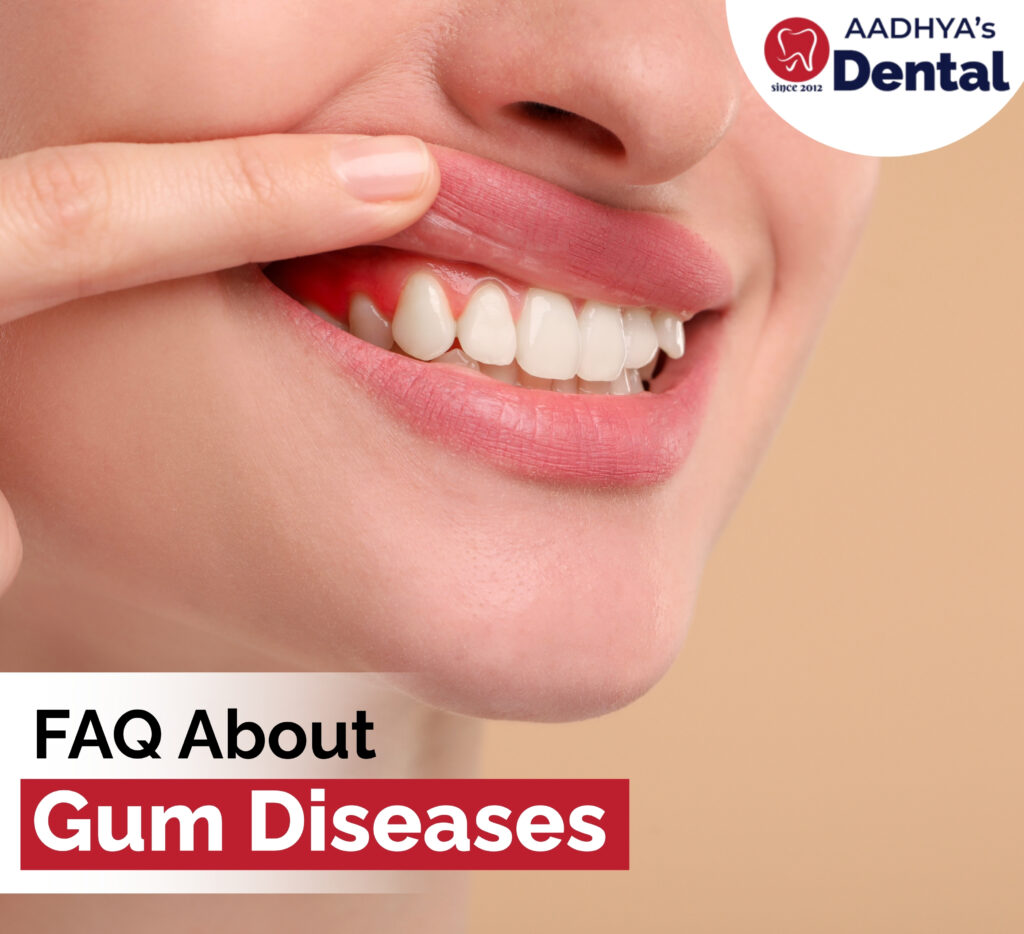
Gum disease, also known as periodontal disease, affects millions of people worldwide and can range from mild inflammation to severe bone loss if left untreated. Despite its prevalence, many patients are unsure about the signs, causes, and best ways to prevent or manage the condition. Through this FAQ, Dr Mrudula experienced in-house gum surgeon at AADHYA’s Dental aims to answer the most common questions about gum disease—from recognizing early symptoms to understanding treatment options and maintaining long‑term oral health. Whether you’re looking for ways to protect your gums or seeking guidance after a diagnosis, the information below provides clear, evidence‑based answers to help you make informed decisions about your dental care.
1. Gingivitis and Periodontal disease – What are they?
- Gingivitis is an inflammation of the gingiva.
- Gingivitis or inflamed gums is the early stage of gum disease, where the inflammation is more restricted to the gum tissue and the colour of the gums surrounding the tooth.
- Gingivitis if not treated and if plaque and tartar surrounding the tooth is not removed, can spread quickly into the other layers of the periodontium (the surrounding support structures for the tooth), affecting the bone, Periodontal ligament.
- At that point, we begin to notice what is known as periodontal disease or full-blown gum disease.
Also Read : https://aadhyasdental.com/myths-about-gum-disease/
2. What are the early warning signs of gum disease?
- One of the problems with gum disease is that it usually does not have many symptoms.
- In the early stages of gum disease, people usually do not notice much of a difference, but if we are looking closely, we can still spot certain signs.
- Gums that bleed easily are among the larger ones.
- Gum bleeding during brushing and flossing is a sign that something is wrong and that there is inflammation in the area.
- In addition, you might notice that the gums become slightly more swollen, more red, and possibly even sensitive.
- You may notice foul breath or other gum changes.
- Gums are pulling away from the teeth, or teeth are becoming loose, and in the later stages of gum disease, permanent teeth may appear to be separating or changing the way they come together when you bite.
- These are usually seen in the later stages of gum disease; However, anything might happen.
For further information about how to prepare for your first visit to a dental clinic Also Read : https://aadhyasdental.com/how-to-prepare-for-your-first-visit-to-a-dental-clinic/
3. Is some bleeding normal, or is it a hint that anything is wrong?
- Generally, healthy gums should not bleed.
- The majority of the time, bleeding in the gums indicates gingivitis, or inflammation of the gums.
- This inflammation may be isolated to a single location of the mouth or it may be rather widespread.
- However, in certain situations, such as when you have not been flossing regularly but are beginning to resume the habit, you will likely notice that your gums bleed initially while you floss.
- However, the bleeding should stop eventually, usually within a week or so.
- Other factors may also contribute to or increase the frequency of bleeding.
- Hormonal changes, such as pregnancy, might increase the frequency of bleeding.
- Patients who take specific drugs, such as blood thinners. Blood thinners may make bleeding slightly more likely, but there are other medical disorders that can also increase bleeding.
- If you experience bleeding that does not go away with regular flossing or appears out of the ordinary for you, you should contact your doctor or dentist.
4. What is the association between gum health and heart health?
- We are aware of the correlation; individuals with heart disease and periodontal disease more frequently have both conditions.
- Heart disease is more common in those with gum disease, and vice versa.
- We still observe a stronger correlation even after adjusting for other shared risk variables in both.
- Additionally, we are aware that maintaining healthier gums and preventing or treating gum disease can have some beneficial benefits and possibly reduce the risk of heart disease.
For further information about Faq About Gum Health Also Read More : https://aadhyasdental.com/faq-about-gum-health/
5. How can we maintain the healthiest possible gums?
- How can we maintain the healthiest possible gums?
- What you do on a daily basis at home is what matters most.
- The first step is to brush for at least two minutes each time, at least twice a day.
- It does not seem like a lot of time, but it can seem like a lot when you are brushing.
- However, there are several things that might help you stay on track.
- Many electric toothbrushes come equipped with timers to assist you keep track of how long you are using them and to set a timer for yourself.
- However, two minutes twice a day might have a huge impact.
- However, even outstanding brushing skills and flawless technique will not be enough to clean in between teeth.
- At least once a day, we must clean between the teeth. We usually use flossing for that.
Also Read : https://aadhyasdental.com/electric-vs-manual-toothbrushes-a-comparison-of-pros-and-cons/
6. How much time should you spend flossing?
- It is not necessary to spend a lot of time flossing. Flossing should be mindful and purposeful.
- Many people simply take the floss and move it quickly and perhaps forcefully up and down in between their teeth.
- To create a wonderful little embrace around the tooth on either side, the floss should be gently wrapped around the teeth.
- However, it need not take a long time. To be honest, you can move around rather nicely in a minute or two.
7. Does your diet matter? Is there anything you should stay away from?
- Your nutrition is where all health begins.
- Our general health and systemic health, as well as the health of your gums, are greatly influenced by our diet.
- Your general health will benefit from a diet high in vegetables, vegetable oils, fruits, legumes, nuts, and healthy fatty fish, among other important nutrients.
- It will also help reduce inflammation and other negative effects.
- All things considered, the mouth also reflects that.
8. Does smoking affects gum health?
- One of the major factors that we are aware has a high correlation with gum disease is smoking.
- Smoking causes damage to the body in many ways, but it can also be a major contributing factor to the development of gum disease, which can be quite severe.
9. Does alcohol consumption affects gum health?
- Inflammation will result from excessive alcohol consumption or even from eating meals high in sugar.
- While these factors are not the cause of gum disease, they can certainly worsen it.
Also Read More : https://aadhyasdental.com/myths-about-gum-disease/
10. How frequently should people schedule dental visits for gum care?
- Yes, it will differ from person to person.
- Gum disease can be effectively managed for some patients by getting a professional cleaning and seeing their dentist more frequently.
- They may visit the dentist once every three or four months.
- At the very least, everyone should be visiting a dentist for a checkup at least once a year, but twice a year usually works really well for those with better gums or gingivitis that is fairly well controlled.
For further information about how to prepare for your first visit to a dental clinic, also read: https://aadhyasdental.com/how-to-prepare-for-your-first-visit-to-a-dental-clinic/
Conclusion
Gum disease is a progressive condition that can be effectively managed when caught early and treated appropriately. By staying informed about the risk factors, recognizing the warning signs, and following a consistent oral – hygiene routine, you can protect your gums and preserve your smile for years to come. If you have any lingering doubts or suspect you may be experiencing symptoms, don’t hesitate to consult a dental professional or call us to talk to Dr Mrudula who can provide personalized advice and treatment. Your gums are the foundation of a healthy mouth—take care of them, and they’ll support your smile for a lifetime.
Website: https://aadhyasdental.com/
Address: Aadhya’s Dental | Best Dental Clinic in Nallagandla
Phone: +91-73962 35802